
Blog
How New York Business Personal Property Tax Rules Apply to Machinery and Equipment
New York does not impose a general annual tax on business machinery and equipment, but equipment built into a building as a fixture can quietly inflate its real property assessment. This guide explains the fixture line, the grievance deadline, and how an independent equipment appraisal separates equipment value from bricks and mortar.
Does New York Tax Business Equipment as Personal Property?
No. New York is one of the states that does not impose a general, recurring tax on business machinery, tools, furniture, or computers as personal property. If you run a business in another state, you may be used to filing an annual business personal property rendition that lists every piece of equipment you own by cost and acquisition date. New York does not require that filing.
What New York taxes at the local level is real property, assessed by your town, city, or county assessor under the Real Property Tax Law (RPTL). Business equipment only enters that picture when it is legally classified as part of the real property itself, typically because it is affixed to a building in a way that makes it a fixture rather than movable machinery. That distinction, not a statewide equipment tax, is what actually drives most of the confusion business owners run into. Understanding where the line falls matters enough that many equipment-heavy businesses bring in our equipment appraisal services specifically to document it.
What New York Taxes Instead: Real Property Assessed Locally
Under RPTL § 102(12), "real property" is defined broadly, and it explicitly sweeps in certain categories of building equipment: boilers, ventilating apparatus, elevators, plumbing, heating and lighting systems, and power generating apparatus, along with equipment used to distribute heat, light, power, gas, or liquids through a building. New York's own assessment guidance confirms this classification applies even to some equipment that could otherwise look like machinery (New York State Office of Real Property Tax Services legal opinions).
The same statute carves out an exception: movable machinery or equipment used for trade or manufacture, owned by a corporation subject to the state's corporate franchise tax, that is not essential to the structural support of the building and can be removed without material damage, stays classified as personal property. It is not taxed.
This is why New York does not run anything like a Texas-style or California-style equipment rendition system. Instead of an annual inventory filing, New York's exposure runs through two separate channels:
- Real property tax, assessed locally on the building and any equipment classified as a fixture under RPTL § 102(12).
- Sales and use tax, charged once at the time equipment is purchased, with an exemption available for qualifying production machinery used directly and predominantly in manufacturing (20 NYCRR § 528.13).
Neither of those is a recurring personal property tax on equipment you already own. A business that has already paid sales tax on a piece of production equipment, or bought it exempt under the manufacturing exemption, generally has no further personal property tax exposure on that asset going forward.
Pro tip: Businesses relocating from a state with an annual rendition requirement often over-report to New York assessors out of habit. There is no form to file listing your machinery inventory here; don't create one.
The Fixture Line: When Equipment Becomes Part of the Real Property Assessment
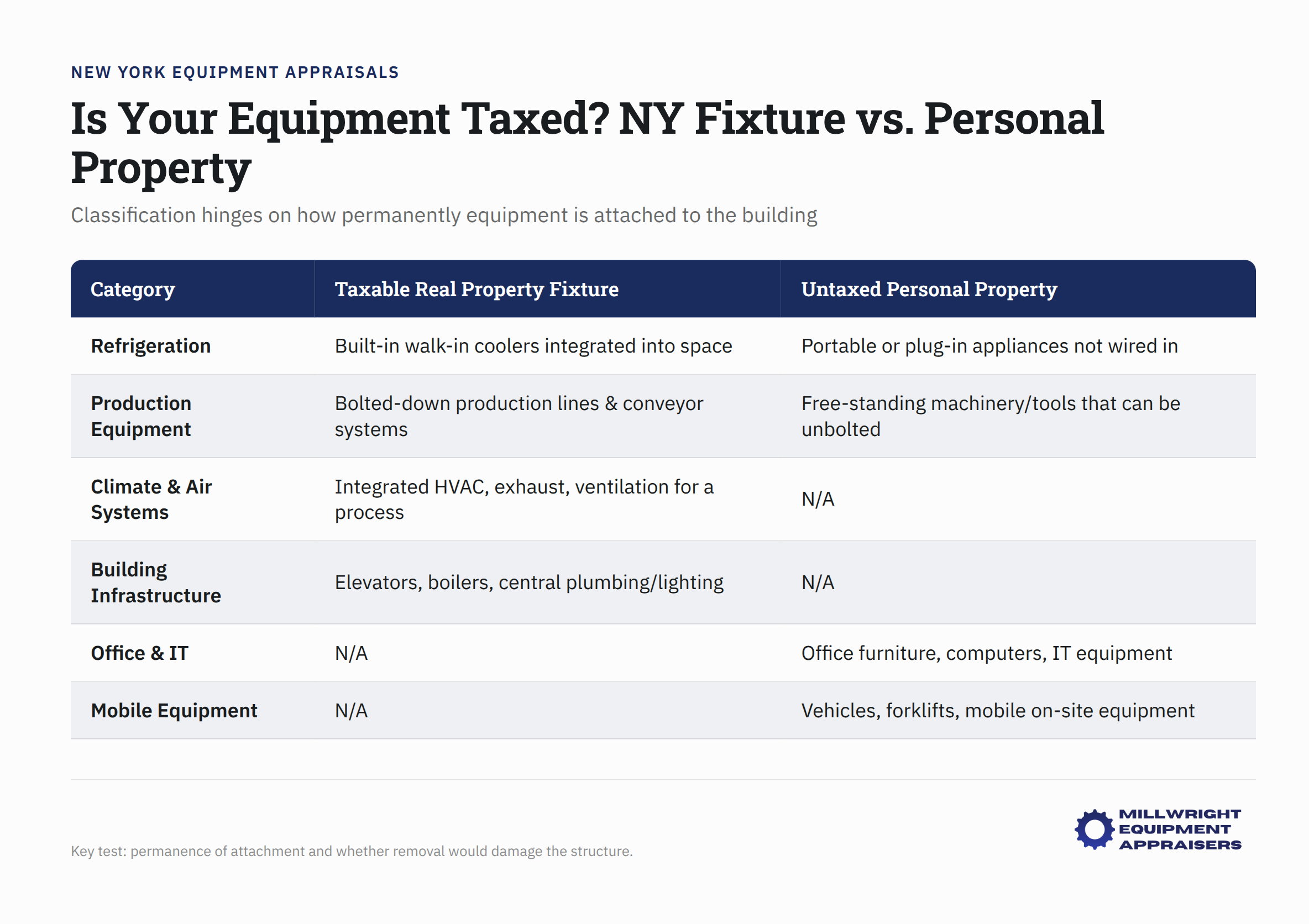
The practical question for most equipment-heavy businesses is simple: does this piece of equipment count as part of the building, or does it stay untaxed personal property? The answer turns on how permanently the item is attached and whether removing it would damage the structure.
Equipment that typically gets swept into a real property assessment as a fixture includes:
- Built-in walk-in coolers and refrigeration units integrated into a restaurant or grocery space.
- Bolted-down production lines and conveyor systems that are structurally integrated with the building.
- Integrated HVAC, exhaust, and ventilation systems serving a specific manufacturing or medical process.
- Elevators, boilers, and central plumbing or lighting infrastructure.
Equipment that generally stays classified as movable personal property, and therefore untaxed, includes:
- Free-standing machinery, tools, and production equipment that can be unbolted and relocated without damaging the building.
- Office furniture, computers, and IT equipment.
- Vehicles, forklifts, and other mobile equipment used on-site.
- Portable or plug-in appliances not wired into the building's systems.
How This Plays Out for Equipment-Heavy Businesses
Manufacturers, warehouses, restaurants, and medical practices are the businesses most likely to feel this line in their tax bill. When an assessor values the real property, they are often working from a cost or income approach applied to the whole building, and it is easy for equipment value to get folded into that number without being separately identified.
Example: A food processing plant installs a bolted-down production line, an integrated exhaust system, and a walk-in freezer during a build-out. If the assessor's valuation model treats the entire build-out cost as building value, the assessment can end up reflecting equipment that, properly classified, has nothing to do with the real property's market value as a structure.
The same pattern shows up in restaurants with built-in kitchen equipment, warehouses with integrated racking or conveyor systems, and medical or dental practices with plumbed-in imaging and treatment equipment. In each case, equipment that should be depreciating separately as a business asset instead gets carried, at inflated value, inside the real property assessment indefinitely.
Watch out: Assessors rarely break out equipment value as a separate line item on the assessment roll. If you don't ask the question, an inflated fixture valuation can sit unnoticed for years.
What to Do When Equipment-as-Fixture Value Inflates Your Assessment
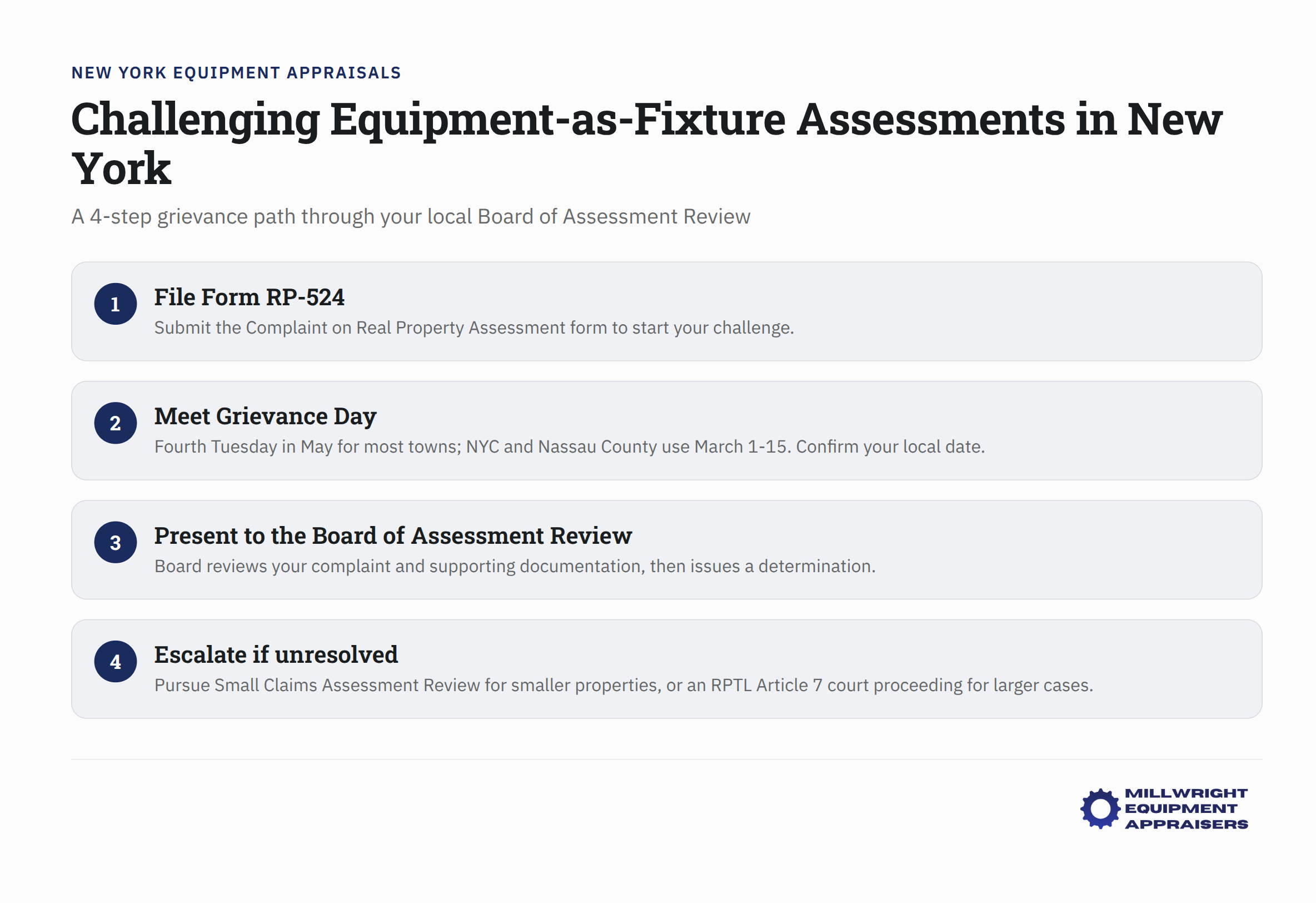
If you believe equipment has been over-valued as part of your real property assessment, New York gives you a formal path to challenge it. The process runs through your local Board of Assessment Review, and it starts with a specific form and a hard deadline.
- File Form RP-524 (Complaint on Real Property Assessment). This is the standard complaint form used to challenge an assessment before most local Boards of Assessment Review.
- Meet Grievance Day. In most towns, Grievance Day falls on the fourth Tuesday in May. New York City and Nassau County run on different calendars, generally in the March 1 to March 15 window, so confirm your municipality's date before filing.
- Present your case to the Board of Assessment Review. The board reviews your complaint and any supporting documentation, then issues a determination.
- Escalate if unresolved. If the board denies or only partially adjusts your complaint, you can pursue Small Claims Assessment Review for smaller properties, or a formal RPTL Article 7 proceeding in state court for larger or more complex assessments.
How an Independent Equipment Appraisal Supports Your Grievance
A grievance built on "this feels too high" rarely moves an assessor or a Board of Assessment Review. A grievance built on a documented, USPAP-compliant valuation that separates equipment from real property does.
An independent equipment appraisal establishes a defensible value for the machinery and fixtures at issue, distinct from the brick-and-mortar value of the building. Our appraisers document the age, condition, and remaining useful life of each item, and account for functional obsolescence (equipment that still runs but no longer fits current production methods) and economic obsolescence (value lost to external market conditions, not the equipment's own wear). That analysis lets an assessor, Board of Assessment Review, or RPTL Article 7 court see exactly how much of the assessed value is attributable to equipment that should never have been folded into the real property number in the first place.
Understanding the difference between what an item would sell for on the open market and what it would bring in a forced or rapid sale also matters when presenting equipment value to an assessor; our guide on fair market value versus liquidation value for New York equipment owners walks through how appraisers select the right standard of value for each purpose.
Machinery and equipment appraisal engagements are quoted as a fixed fee, scoped to the number of assets, the quality of existing records, and the depth of analysis a grievance requires, never billed hourly and never priced off the equipment's market value itself. Typical machinery and equipment appraisal fees for this kind of assignment run from $695 to $3,000, with larger or more complex facilities running higher.
Key takeaway: New York doesn't tax your equipment directly, but a poorly documented real property assessment can tax it anyway, through the back door of fixture classification. A grievance backed by an independent equipment appraisal is the tool that separates the two.
If your business has bolted-down production equipment, built-in refrigeration, or integrated mechanical systems that may be inflating your real property assessment, our team can prepare a USPAP-compliant equipment appraisal sized to your grievance deadline and the scope of your facility.
This article is provided for general informational purposes only and does not constitute legal, tax, or financial advice. Readers should consult a qualified attorney or CPA regarding their specific circumstances.