
Blog
Fair Market Value vs Liquidation Value for New York Equipment Owners Explained
Fair market value, orderly liquidation value, and replacement cost new answer different questions about the same machine, and using the wrong one can sink an estate filing, a loan application, or an insurance claim. This guide matches each standard to the New York situation it actually fits.
Equipment owners across New York, from manufacturers in Buffalo to construction contractors on Long Island to dairy and produce operations upstate, run into the same confusion: an appraiser hands them a number, and they assume it's the number. It isn't. A single forklift or CNC machine can carry three different, equally correct values depending on the question being asked. Understanding fair market value vs liquidation value for equipment, and where replacement cost fits into that picture, determines whether your appraisal actually holds up for the purpose you need it for.
What Is Fair Market Value for Equipment, and Why Does the IRS Require It?
Fair market value (FMV) is the price at which equipment would change hands between a willing buyer and a willing seller, neither one under any compulsion to act, and both reasonably informed about the asset. That definition traces directly to federal tax regulations and is repeated in IRS Publication 551, which governs how basis and value are established for tax purposes. It assumes a normal, unhurried market, not a distressed sale and not a rushed purchase.
The IRS requires FMV specifically for estate tax filings (Form 706), gift tax filings, and charitable contribution deductions (Form 8283). IRS Publication 561 is the guidance most appraisers lean on when valuing donated or estate-held property, and it treats FMV as the only acceptable conclusion for those filings, even when other cost or liquidation data is considered along the way. Professional appraisal organizations describe the same standard: the International Society of Appraisers frames fair market value determination around that willing buyer, willing seller test, with both parties acting free of pressure.
For a New York business owner, this is the standard that matters when equipment changes hands through an estate, a gift, a donation, or a buy-sell agreement. If you're transferring a family manufacturing business or settling an estate that includes farm or shop equipment, our New York estate tax and equipment appraisal guide walks through how FMV gets applied in that specific filing context.
Key takeaway: if the IRS, a court, or a CPA is asking what the equipment is worth for tax or transfer purposes, the answer they want is fair market value, not what a lender could get for it at auction next month.
Orderly Liquidation Value vs Forced Liquidation Value: What's the Difference for Loan Collateral?
Orderly liquidation value (OLV) is the gross amount equipment would realize in a liquidation sale given a reasonable period of time to find a buyer, with the seller compelled to sell on an as-is, where-is basis. Forced liquidation value (FLV) answers a narrower question: what would the same equipment bring at a properly advertised public auction with a sense of immediacy, no waiting for the ideal buyer. The American Society of Appraisers maintains both definitions as recognized premises of value within machinery and equipment appraisal, and the distinction between them comes down entirely to time.
Both assume compulsion, which is exactly what fair market value excludes. That's the point: OLV and FLV exist to answer the question "what happens if this has to be sold quickly," not "what would it sell for under normal conditions."
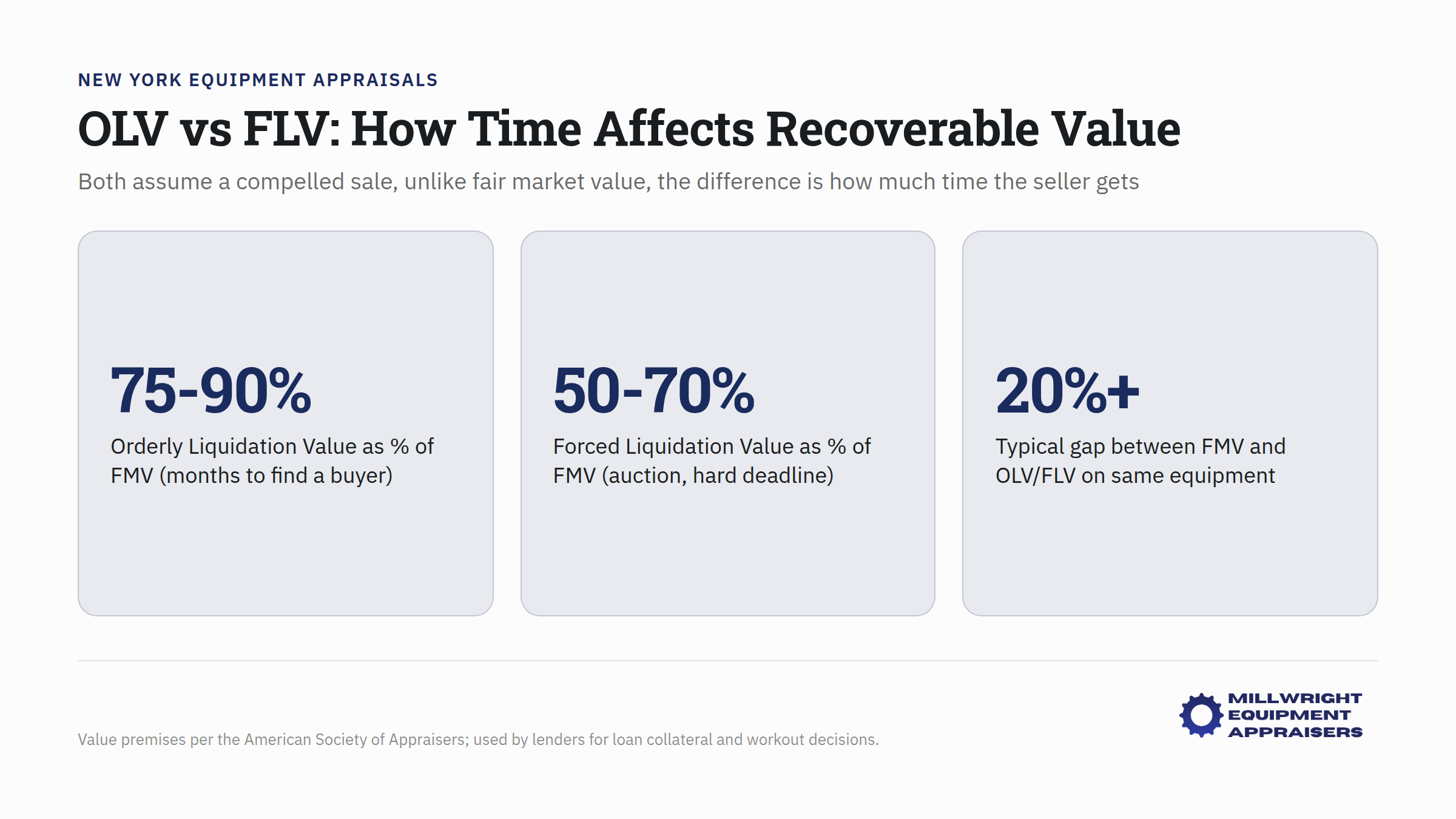
Industry practice generally places orderly liquidation value in the range of 75% to 90% of fair market value, since a planned sale over several months still gives the seller time to find reasonable offers. Forced liquidation value typically runs lower, often 50% to 70% of fair market value, because an auction with a hard deadline eliminates the negotiating leverage a seller would otherwise have.
Lenders are the primary users of orderly liquidation value in New York. When equipment secures a loan, an asset-based lender or bank wants to know what it could actually recover if the borrower defaulted and the collateral had to be sold within a defined workout period, not what the equipment is worth to a business that's using it productively. That's why loan applications, borrowing base calculations, and workout negotiations almost always specify OLV rather than FMV. If you're trying to understand how a lender or appraiser arrives at that recoverable number for used machinery, our answer to how you determine the value of used equipment breaks down the comparison approach appraisers use to get there.
Watch out: submitting a fair market value appraisal when a bank asked for orderly liquidation value is a common and avoidable mistake. The two numbers can differ by 20% or more on the same piece of equipment, and a lender reviewing collateral will simply reject a report built on the wrong premise.
Replacement Cost New: The Insurance Standard
Replacement cost new (RCN) answers yet another question entirely: what would it cost today to acquire a brand-new piece of equipment of like kind and capability? It has nothing to do with what a buyer would pay for the used item and nothing to do with a distressed sale. It's a cost estimate, not a market transaction price.
Insurers rely on replacement cost new to set coverage limits and to settle claims on damaged or destroyed equipment, because a policy is generally designed to make the owner whole by funding a new purchase, not by paying out what a used unit would have fetched on the open market. A manufacturer in Rochester insuring a production line, or a construction firm in Westchester covering excavators and loaders, will typically see RCN used to schedule values and calculate claim payouts.
The IRS treats replacement cost very differently. IRS Publication 561 allows replacement cost to be considered as one factor in reaching a fair market value conclusion, but only when there's a reasonable, demonstrable connection between the cost to replace an item and what it would actually sell for used. Replacement cost is an input an appraiser may weigh, never a standalone substitute for FMV on an estate or donation filing.
Matching the Standard to Your Situation
The table below lines up the three standards against the New York use cases where each one actually applies.
| Standard of Value | Core Definition | Typical New York Use Case | Who Typically Requires It |
|---|---|---|---|
| Fair Market Value | Price between a willing, informed buyer and seller, neither under compulsion | Estate settlement, gift tax, charitable donation of equipment | IRS (Forms 706, 8283), courts, CPAs, attorneys |
| Orderly Liquidation Value | Gross amount realizable in an as-is sale, seller compelled but given reasonable time | Equipment-backed loan collateral, workouts, restructuring | Banks, asset-based lenders, trustees |
| Forced Liquidation Value | Gross amount realizable at a properly advertised auction with immediate urgency | Distressed sale, foreclosure, rapid wind-down | Lenders in default scenarios, insolvency proceedings |
| Replacement Cost New | Current cost to acquire a new asset of like kind and utility | Insurance scheduling and claims | Insurers, risk managers |
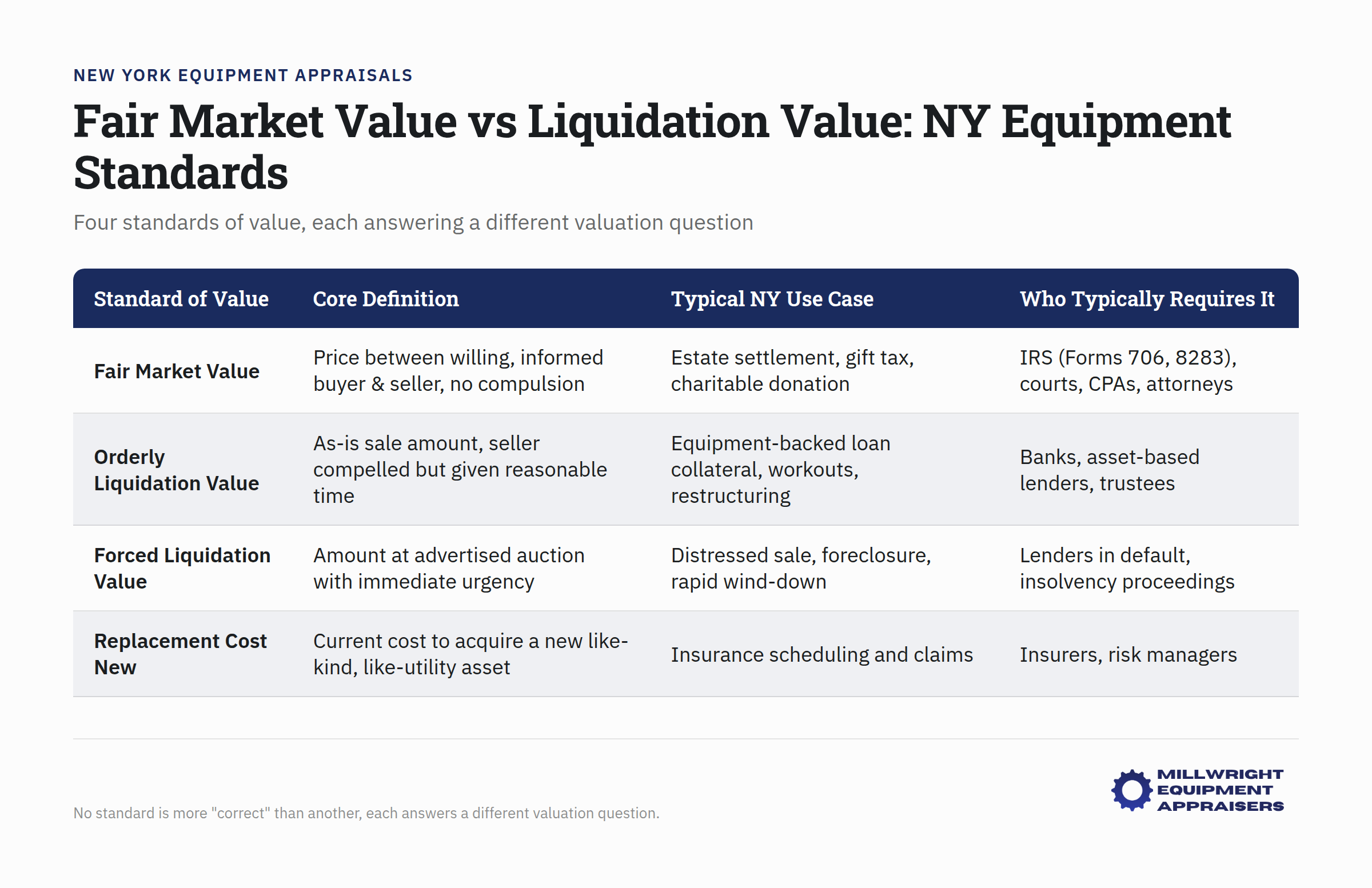
The common thread is that none of these standards is more "correct" than another. Each one is the right answer to a different question, and the appraiser's job starts with confirming which question is actually being asked before any valuation work begins.
Why the Standard You Choose Changes the Value, Not the Appraisal Fee
It's worth separating two things that get confused: the premise of value affects the number the appraisal concludes, while the fee for producing that appraisal is driven by the scope of the assignment. A machinery and equipment appraisal engagement is quoted as a fixed fee after we scope the project, based on factors like how many assets are involved, how complete the existing records are, and whether the report needs to meet IRS-qualified appraisal standards or a standard reporting format. Our published fees for machinery and equipment appraisals start at $295 for standard reports and $395 for IRS-qualified reports, with most engagements running $695 to $3,000 depending on the number and complexity of the assets involved. Larger, multi-site industrial portfolios can run into the $5,000 to $10,000-plus range. These engagements are always quoted up front as a fixed fee, never billed hourly, regardless of whether the assignment calls for fair market value, orderly liquidation value, or a replacement cost analysis.
Pro tip: tell your appraiser the intended use of the report (IRS filing, loan collateral, or insurance claim) at the outset. That single detail determines the premise of value the report is built around, and getting it wrong after the fact usually means starting over.
Our appraisers hold credentials with organizations such as the ASA, ISA, CAGA, and NEBB's Certified Machinery and Equipment Appraiser program, and every report we prepare follows the Uniform Standards of Professional Appraisal Practice (USPAP) set by The Appraisal Foundation. That consistency matters because a bank, an IRS reviewer, and an insurance adjuster are each going to scrutinize the report for a different reason, and a USPAP-compliant report is built to withstand that scrutiny regardless of which premise of value it uses.
Getting the Right Appraisal for Your Equipment
The fastest way to end up with an appraisal that doesn't serve its purpose is to skip the conversation about which value standard applies. An estate attorney needs fair market value. A lender needs orderly liquidation value. An insurance carrier needs replacement cost new. Naming the intended use before the engagement starts is what lets an appraiser scope the work correctly and land on a defensible, USPAP-compliant number the first time.
If you're not sure which standard your situation calls for, or you need an appraisal that will hold up with the IRS, a lender, or an insurer, request an equipment appraisal and our team will confirm the right premise of value before any work begins.
This article is provided for general informational purposes only and does not constitute legal, tax, or financial advice. Readers should consult a qualified attorney or CPA regarding their specific circumstances.