
Blog
Equipment Appraisal for SBA Loan New York: What Lenders Require in the Report
An equipment appraisal for an SBA loan in New York is an independent opinion of collateral value that your lender uses to size and secure the loan. This guide covers which value basis lenders ask for, what the report must contain, and how to prepare so the file moves quickly.
An equipment appraisal for an SBA loan in New York gives your lender an independent, documented opinion of what your machinery and equipment is worth as collateral. That number, and the value basis behind it, often decides how much of the loan the equipment can support. This guide covers why lenders ask for the appraisal, which value basis they use, what the report must contain, and how to prepare. If you already know you need one, you can request an equipment appraisal at any time.
Key takeaway: For most lender-driven equipment appraisals, the report states a liquidation-based value (what the equipment would realistically bring if the lender had to sell it), and that value, not your purchase price, drives how much the lender will advance against the equipment.
Why Do SBA and Bank Lenders Want an Independent Equipment Appraisal?
Lenders want an independent equipment appraisal because they cannot verify a borrower's value claims on their own. The collateral has to be identified, valued, and supportable if the loan defaults and the lender has to sell the assets.
A lender is not interested in owning your CNC machines, excavators, or restaurant line. It wants cash back, as quickly as possible, if repayment fails. An appraisal prepared by a credentialed third party tells the credit committee what that recovery might look like, using market evidence instead of the borrower's book values or the seller's asking price.
The appraisal does not stand alone. It sits alongside proof of ownership, a security agreement, UCC lien searches, and insurance. In New York, Article 9 of the Uniform Commercial Code governs security interests in equipment, and perfecting and prioritizing that lien is a separate legal step. The appraisal supports the loan file; it does not replace any of those documents.
Does SBA Require an Equipment Appraisal?
SBA does not impose one universal equipment appraisal format on every loan. SBA's loan regulations give the agency authority to require professional appraisals of an applicant's assets, but they leave the decision to the circumstances of the credit.
In practice, whether an appraisal is required depends on your lender's credit policy and the SBA program involved (7(a), 504, or another). Your lender will tell you when one is needed. We do not quote a dollar threshold here, because published sources conflict and the lender's current policy is what controls.
An independent appraisal is more likely when any of these facts are present:
- The equipment is used, heavily depreciated, or specialized.
- The borrower's stated value is well above net book or tax value.
- The loan depends heavily on recovering value from the collateral.
- The equipment is being acquired from a related party or as part of a business acquisition.
- The lender needs liquidation values, not purchase-price evidence.
Brand-new equipment bought at arm's length is a different case. A lender may accept the invoice or dealer quote as evidence of value, so the appraisal question mostly arises with used and existing equipment.
Which Value Basis Do Lenders Ask For?
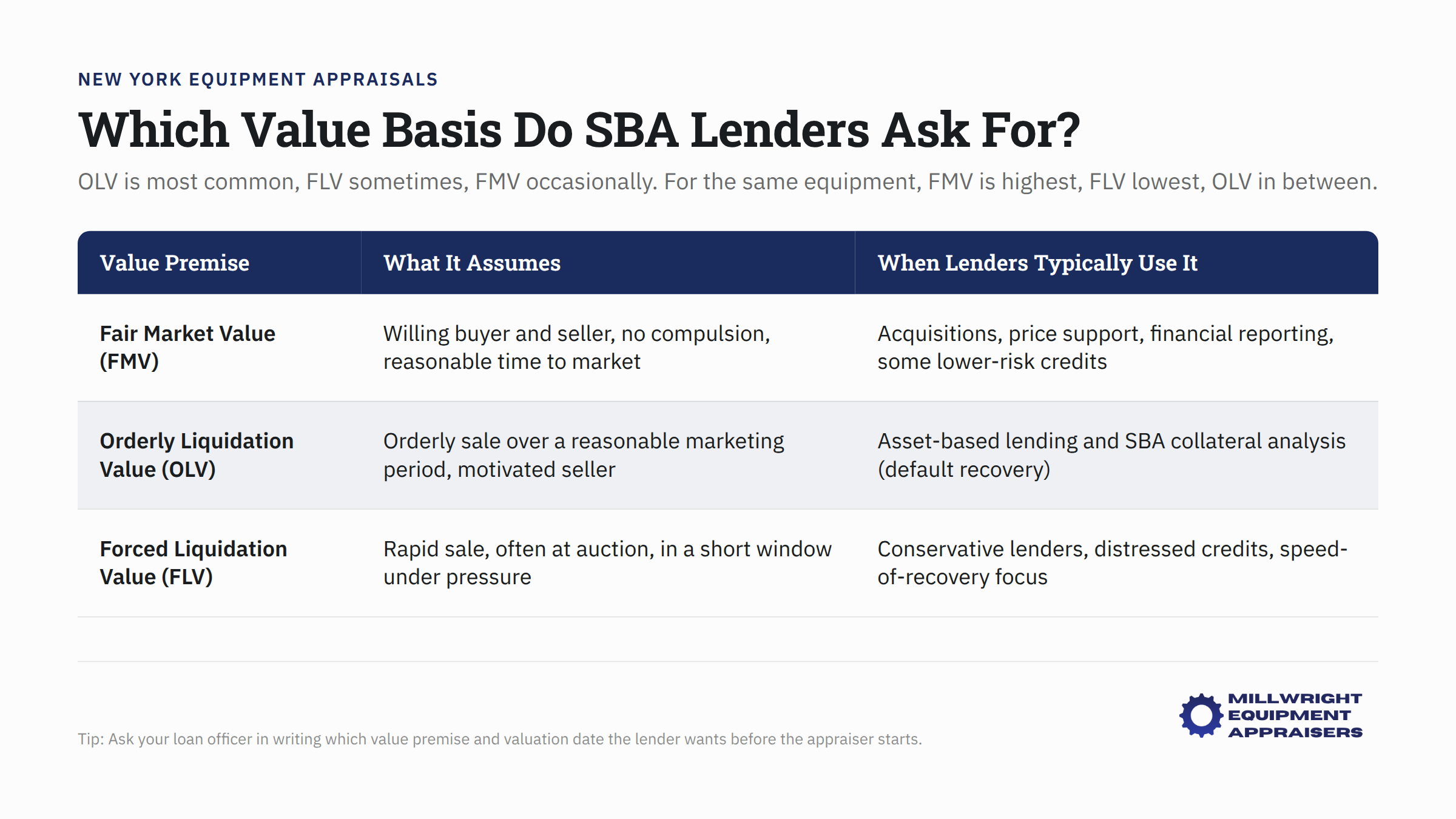
Lenders most often ask for orderly liquidation value (OLV), sometimes forced liquidation value (FLV), and occasionally fair market value (FMV). The right basis depends on how the lender plans to recover its money and what its policy requires. The table below compares the three.
| Value Premise | What It Assumes | When Lenders Typically Use It |
|---|---|---|
| Fair Market Value (FMV) | A willing buyer and seller, neither under compulsion, with reasonable time to market the asset | Acquisitions, purchase-price support, financial reporting, some lower-risk credits |
| Orderly Liquidation Value (OLV) | A sale in an orderly manner over a reasonable marketing period, with the seller motivated to sell | Asset-based lending and SBA collateral analysis where recovery in default is the question |
| Forced Liquidation Value (FLV) | A rapid sale, often at auction, within a short window and under pressure | Conservative lenders, distressed credits, or when speed of recovery matters most |
The three are not interchangeable. FMV is the highest of the three for the same equipment, FLV is typically the lowest, and OLV usually falls between them. We cover the definitions in more detail in our post on fair market value vs liquidation value for New York equipment owners.
Watch out: Ordering the wrong premise is the most common avoidable mistake. Ask your loan officer, in writing, which value and which valuation date the lender wants before the appraiser starts work.
How Does Appraised Value Feed Collateral and Loan-to-Value?
Lenders advance a percentage of appraised value, not 100%, and liquidation-based values already run lower than market value. The result is that equipment often supports a smaller loan than the borrower expects.
SBA applies its own haircuts when it tests whether a loan is fully secured. Under SBA SOP 50 10 8, used or existing machinery and equipment is generally valued at no more than 50% of net book value, or 80% of the value supported by an orderly liquidation appraisal, less prior liens. SBA publishes updated versions of its SOPs (SOP 50 10 8.1 is identified as effective October 1, 2026), so confirm with your lender which version applies to your loan.
Example: A New York fabrication shop owns equipment with a $400,000 fair market value and a $300,000 orderly liquidation value. Its net book value is $350,000, and no other lender has a lien on the equipment.
- At an 80% advance on FMV, the equipment would appear to support $320,000.
- At 80% of the $300,000 OLV, the equipment is valued for collateral purposes at $240,000.
- At 50% of the $350,000 net book value, the equipment is valued at $175,000.
In this example the orderly liquidation appraisal supports $65,000 more than the net book value route, but $80,000 less than a market-value advance would have suggested. If a prior lien of $40,000 existed, the collateral credit would fall to $200,000. Your lender runs these calculations under its own policy, so treat the figures as an illustration of the mechanics, not a forecast.
What Must the Equipment Appraisal Report Contain?
A lender-ready equipment appraisal report identifies each asset specifically, states the value basis clearly, and shows the market evidence behind the conclusion. Lenders review these reports for completeness before they rely on them. At minimum, ours includes:
- Itemized equipment schedule: make, model, serial number, year, specifications, and capacity for each asset.
- Condition: operating condition, hours or usage, maintenance history, obsolescence, and needed repairs.
- Location: where each asset sits, which matters for removal and resale costs.
- Valuation date: the effective date of the opinion, plus the inspection date if applicable.
- Premise of value: FMV, OLV, or FLV, defined in the report.
- Methodology: the market, cost, and income approaches considered, with comparable sales, dealer listings, and auction data.
- Assumptions and limiting conditions: such as lien-free title and no hidden defects.
- Intended use and intended user: the lender is named as the intended user, and the stated purpose is collateral evaluation.
- Appraiser credentials and independence: the appraiser has no financial interest in the equipment or the loan outcome.
- Standards compliance: prepared in accordance with USPAP, published by The Appraisal Foundation.
Our appraisers hold credentials with leading organizations such as the ASA, CAGA, and NEBB (CMEA), which are the credential bodies most relevant to machinery and equipment valuation. Credentials support the work; the lender still decides whether a given report meets its requirements.
What Is Different About New York Equipment Markets?
New York is not one equipment market. Used-equipment demand, dealer depth, and auction activity differ between downstate metro areas, the Hudson Valley, and upstate regions such as Western New York, the Finger Lakes, and the North Country. A piece of agricultural, construction, or manufacturing equipment can have a different realistic resale picture depending on where it sits and how far a buyer would have to travel.
A good appraisal uses comparables that fit the equipment's actual market and accounts for removal and transport. That matters most under liquidation premises, where location directly affects recovery.
Multi-site borrowers add another wrinkle. If your equipment is spread across plants, yards, or job sites, and your lender or SBA-approved lender processes the file from elsewhere, delivery format matters. Machinery and equipment appraisals are available both online and on-site; most engagements are completed online using photos, documentation, and market research, and on-site work is generally reserved for much larger projects. We explain how that works in our guide to remote equipment appraisals for multi-site New York businesses. Your lender may still require an inspection under its own policy, so confirm that early.
Who Orders the Appraisal, and Who Decides If It Is Acceptable?
In most lending situations the lender either orders the appraisal or must approve the appraiser the borrower selects, and the lender decides whether the report is acceptable. The report is prepared for the lender's use, with the lender named as the intended user, even when the borrower pays for it.
Before you engage anyone, ask your loan officer these questions:
- Does the lender order the appraisal, or may the borrower select the appraiser?
- Does the lender maintain an approved-appraiser list or minimum credential requirements?
- Which premise of value and valuation date are required?
- Is an on-site inspection required, or is a remote appraisal acceptable?
- How old can the appraisal be at closing?
An appraisal is a supporting document, not a loan decision. Nothing in the report guarantees approval; it gives the lender a standards-based valuation to use in its own credit decision.
How Do You Prepare for a Lender Equipment Appraisal?
The fastest equipment appraisals start with a clean, complete asset package. Gather these items before the appraiser begins:
- Build the Equipment List
- List every asset to be appraised with make, model, serial number, year, and location. A spreadsheet from your fixed-asset register is a good starting point.
- Collect Purchase Invoices and Records
- Include bills of sale, invoices, major repair or rebuild records, and maintenance logs. These help establish age, condition, and any significant upgrades.
- Take Clear Photos
- Photograph each asset, its data plate showing the serial number, and any damage or wear. Include a wide shot showing how and where it is installed.
- Gather UCC and Lien Information
- Provide existing lender names, UCC filings, equipment leases, and payoff statements. Prior liens reduce the collateral credit, so the lender will want them identified.
- Arrange Access and Contacts
- Name a contact who can answer questions about operation and condition, and confirm access if an inspection is needed.
- Confirm Lender Requirements in Writing
- Get the premise of value, valuation date, intended-user wording, and any report format requirements from the lender before work starts.
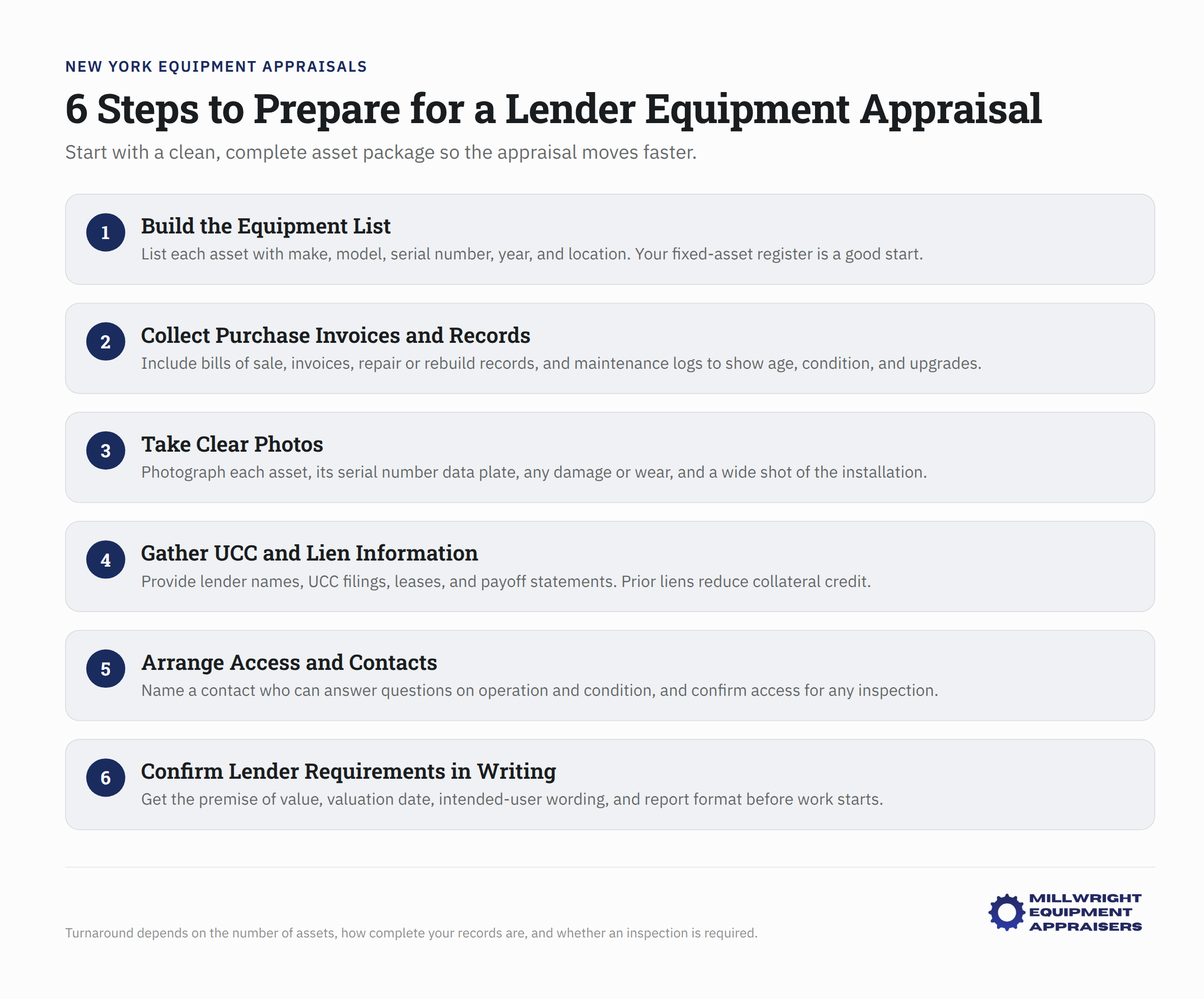
Turnaround depends mainly on the number of assets, how complete your records are, and whether an inspection is required. We confirm the timeline when we scope the engagement, which is worth doing early because loan closing dates often drive the schedule.
What Does an Equipment Appraisal for Lending Cost?
The fee for a lender-focused equipment appraisal is quoted as a fixed fee after we scope the assignment, and it is never billed hourly. Scope is what moves the price: the number of assets, the complexity of the equipment, the quality and completeness of your records, and the intended use and depth of analysis the lender requires.
The value of your equipment affects the concluded value, not what the appraisal costs. You will have the fixed fee in hand before any work begins.
Start the Appraisal Early and Ask the Lender First
The smoothest SBA and bank equipment loans start with a short conversation: confirm the value basis, the version of the SBA SOP the lender is applying, and whether the lender or the borrower orders the report. Then assemble the equipment list, invoices, photos, and lien information so the appraisal can start without delays. With the right premise of value and a complete schedule, the report gives your lender what it needs to evaluate the collateral. Acceptance remains the lender's decision.
This article is provided for general informational purposes only and does not constitute legal, tax, or financial advice. Readers should consult a qualified attorney, CPA, or their lender regarding their specific circumstances.