
Blog
Equipment Appraisal for Probate in New York: An Executor's Guide to Surrogate's Court
Settling a New York estate with a shop, farm, medical practice, or restaurant means filing a formal Inventory of Assets with Surrogate's Court, and that filing often requires a dated, USPAP-compliant equipment appraisal for probate rather than a guessed figure. This guide walks executors through when a full appraisal is required, what it must contain, and how to order one.
When a New York executor takes over an estate that includes a shop full of tools, a farm's tractors and implements, a medical practice's equipment, or a restaurant's kitchen line, the equipment doesn't value itself. Surrogate's Court expects a defensible figure tied to the date of death, and the IRS expects the same figure if the estate has to file a federal return. This guide walks through how New York's probate courts handle business equipment, when a full appraisal is required instead of a simple list, and what a proper report needs to contain.
How New York's Surrogate's Court System Is Organized
New York does not have a single statewide probate court. Each of the state's 62 counties has its own Surrogate's Court, and that includes each of the five New York City boroughs (Bronx, Kings, New York, Queens, and Richmond), which each operate as separate Surrogate's Courts rather than one combined city court. An executor files the probate proceeding, and later the estate inventory, in the county where the decedent was domiciled at death.
That local structure matters for equipment owners because the clerk's office, the filing forms, and local practice can vary slightly by county even though the underlying rule is statewide. If a decedent owned a manufacturing shop in one county and lived in another, the executor still files where the decedent was domiciled, not where the equipment sits.
The Executor's Duty to File an Inventory of Assets
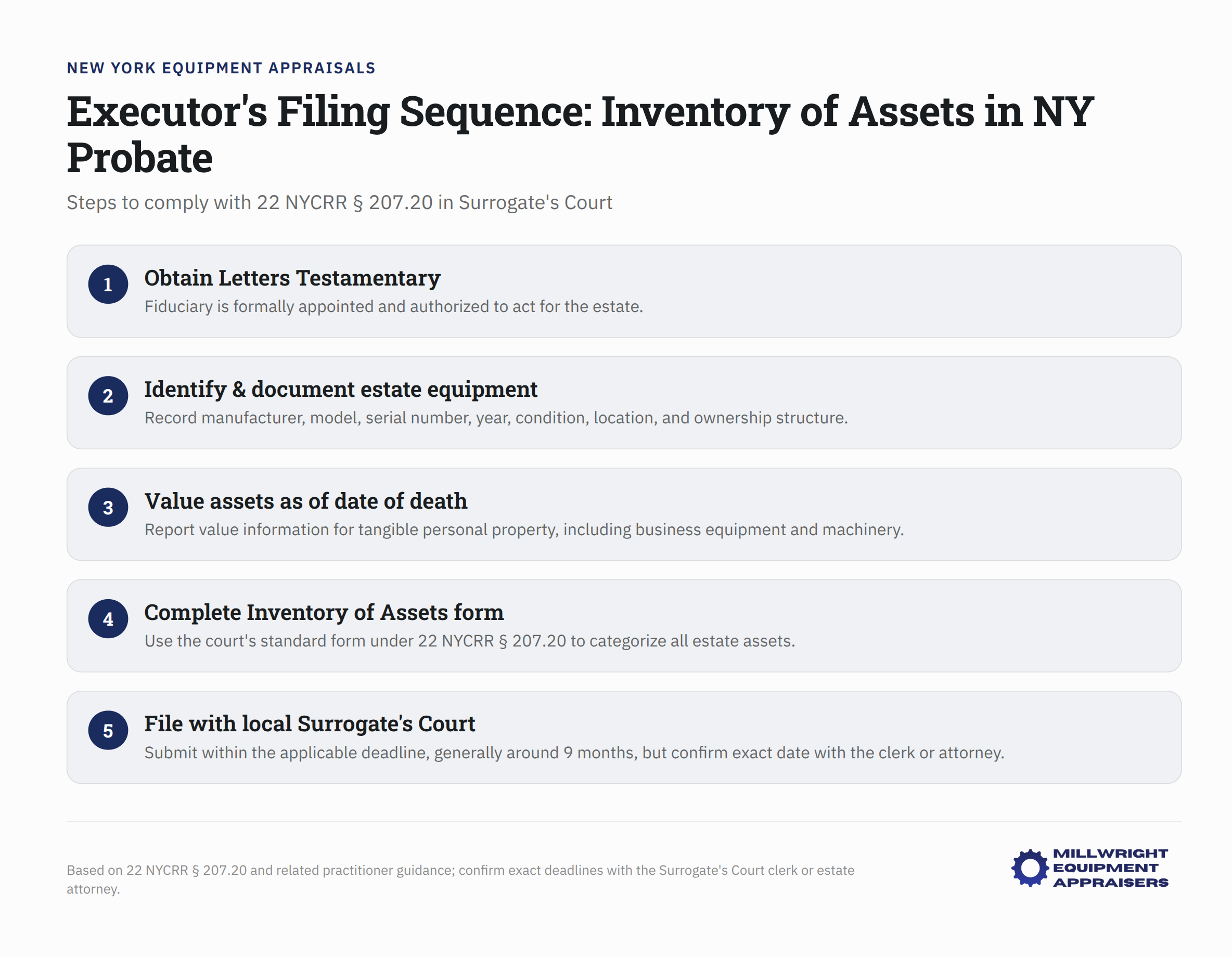
An executor in New York must file a formal Inventory of Assets with Surrogate's Court under 22 NYCRR § 207.20, using the court's standard form. The form asks the fiduciary to identify estate assets by category, including tangible personal property such as business equipment and machinery, and to report value information as of the date of death.
The timing rule is where executors most often get tripped up. Court guidance and practitioner explanations describe the inventory as generally due within 9 months of receiving letters testamentary, though some published guidance ties the deadline instead to the estate tax return date or a shorter window depending on the proceeding. Because the applicable deadline can shift with the specific decree and county practice, confirm the exact due date with the Surrogate's Court clerk or the attorney handling the estate rather than assuming a single fixed number applies to every case.
The inventory itself is a summary filing, not a full appraisal report. Equipment still needs enough detail to be identifiable: manufacturer, model, serial number, year, condition, location, and whether the estate owns it outright or through a business entity, lease, or financing arrangement. Business interests and tangible personal property are both squarely within what an executor must account for as part of settling the decedent's estate.
Estate tax planning for New York businesses that hold significant equipment often starts with this same inventory step, since the values reported to Surrogate's Court frequently carry forward into any state or federal tax filing the estate later has to make.
When a Simple List Is Enough vs. When You Need a Formal Appraisal
A quick dealer quote or an executor's own estimate can be adequate support for modest, easily replaced equipment with an obvious secondhand market. A formal, independent appraisal becomes important once the equipment is a meaningful share of the estate or the numbers are likely to be questioned.
A formal appraisal is particularly worth commissioning when any of the following apply:
- The equipment is specialized, custom-built, or represents a large fleet or an entire production line.
- Beneficiaries disagree about the value of what's being divided or distributed in kind.
- The equipment is being sold or transferred to a related party, such as a family member continuing the business.
- The estate is required to file IRS Form 706.
- The equipment is subject to a lien, lease, or purchase-money financing that affects the estate's true interest in it.
- The reported value could materially affect fiduciary commissions, tax liability, or an accounting that beneficiaries will review.
Separately, New York estate practice has long treated personal property valued above a modest dollar threshold as needing appraisal by a disinterested, qualified appraiser rather than the executor's own estimate. Whatever the exact figure in a given proceeding, the principle holds: once equipment value climbs past pocket-change territory, an independent, itemized appraisal protects the executor from later disputes and second-guessing.
What the Appraisal Report Must Contain
An equipment appraisal for probate has to answer one core question: what was this equipment worth on the date of death? The standard is fair market value, meaning the price a willing buyer would pay a willing seller, with neither party under pressure to act and both having reasonable knowledge of the relevant facts. That is a different number than original purchase price, depreciated book value, insurance replacement cost, or an optimistic asking price, and the distinction between a fair-market figure and a liquidation figure matters a great deal when equipment is being sold to settle debts rather than distributed to heirs.
A defensible report should be prepared in accordance with the Uniform Standards of Professional Appraisal Practice (USPAP) and should include, for each significant item or group:
- The legal owner and the estate's actual interest in the asset.
- Make, model, serial number, year, location, and quantity.
- Operating condition, maintenance history, and any attachments or accessories.
- Liens, leases, or financing that affect what the estate actually owns.
- Comparable sales or dealer market evidence supporting the concluded value.
- The effective date of value, which is normally the date of death.
In most cases the date of death is the effective date used throughout the report. An executor can instead elect the federal alternate valuation date on Form 706 in certain circumstances, but that election has to be made properly on the return; it isn't automatic just because equipment sells later for a different price.
How the Appraisal Feeds Into IRS Form 706
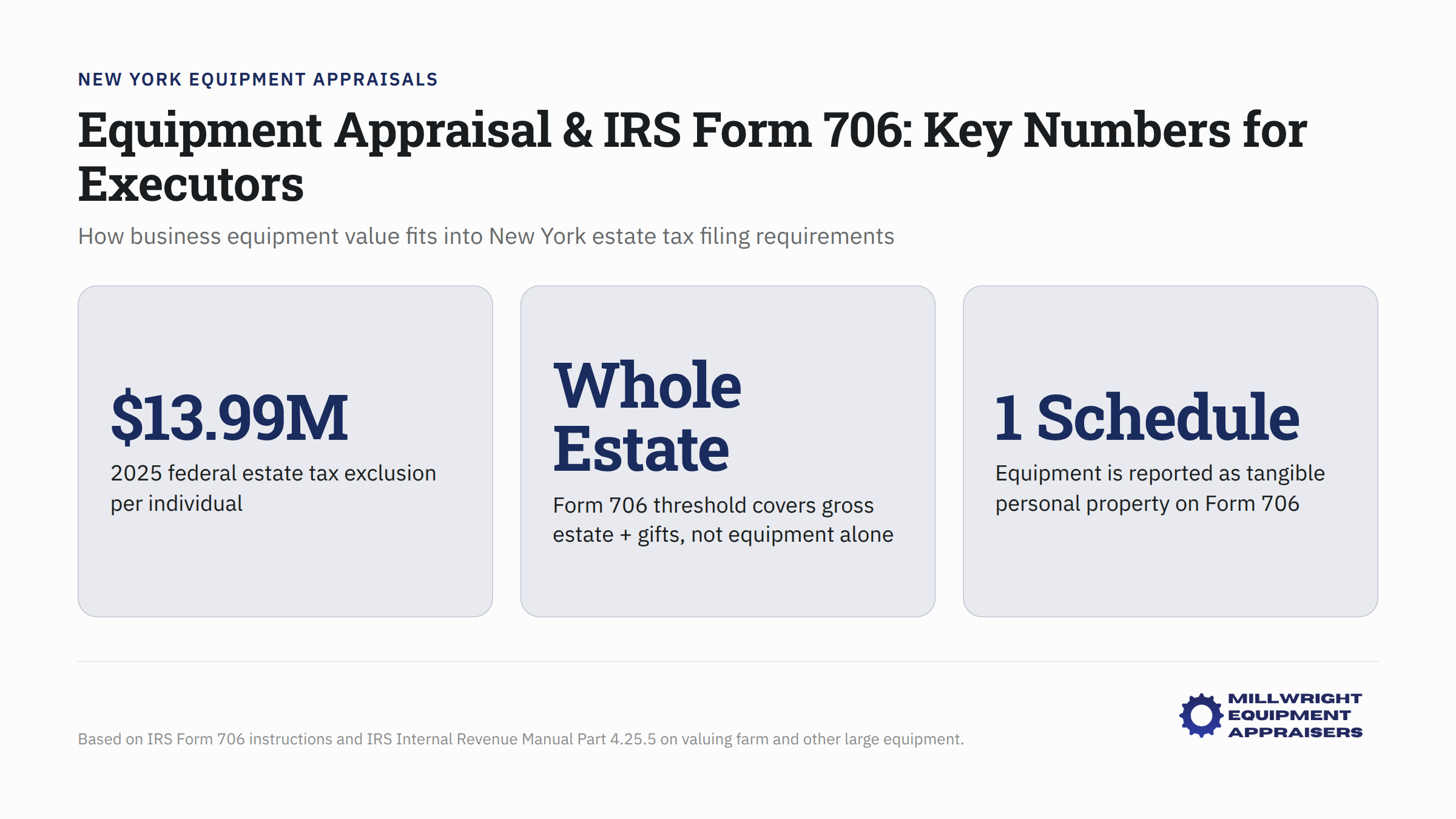
Business equipment that belonged to the decedent is generally reported as tangible personal property on the applicable schedule of Form 706, the federal estate tax return. The IRS requires assets on that return to be valued and reported under the federal estate tax valuation rules, and its examination guidance specifically addresses how farm and other large equipment should be valued, confirming that equipment is treated as a genuine valuation question rather than a simple depreciation lookup.
Whether Form 706 is required at all depends on the size of the decedent's gross estate plus adjusted taxable gifts, measured against the applicable exclusion amount for the year of death, which is $13.99 million per individual for estates of decedents dying in 2025. That threshold has nothing to do with equipment specifically; it's a whole-estate calculation, so an estate with modest equipment but substantial real estate or investment holdings can still cross the filing line.
Ordering an Equipment Appraisal for Probate
Executors don't need to become valuation experts themselves. The practical work is mostly about assembling records and choosing the right appraiser.
- Confirm what the estate actually owns. Pull titles, purchase invoices, fixed-asset ledgers, leases, loan documents, and UCC filings before assuming the equipment is a probate asset rather than something owned by a corporation, LLC, or lender.
- Gather condition and history documentation. Maintenance records, photographs, and usage logs help an appraiser support the conclusion of value and shorten the inspection process.
- Engage a qualified, independent appraiser. Look for appraisers credentialed as Certified Machinery & Equipment Appraisers (CMEA) through NEBB, or accredited through the American Society of Appraisers (ASA), and confirm the engagement will be prepared in accordance with USPAP.
- Set the correct effective date. Make sure the engagement letter specifies the date of death (or a properly elected alternate valuation date) as the effective date of value, not the appraisal's inspection date.
- Review the report before it's filed. Check that every item is itemized with enough identifying detail to survive scrutiny from beneficiaries, the Surrogate's Court, or, on larger estates, the IRS.
For shop equipment, farm machinery, medical equipment, and restaurant kitchens, our fees for a machinery and equipment appraisal typically start at $295 for a standard report and $395 for an IRS-qualified report, with most estate engagements running between $695 and $3,000 depending on how many items are involved and how much documentation already exists. Larger fleets or highly specialized equipment can run higher. Every engagement is quoted as a fixed fee once we understand the scope, never billed by the hour.
Getting the Number Right the First Time
A rushed or informal equipment estimate might get an inventory filed on time, but it creates real risk if beneficiaries later question the number or if the estate ends up filing Form 706. A dated, itemized, fair-market-value appraisal protects the executor's decision-making and gives the Surrogate's Court, the IRS, and the family a figure everyone can rely on. If your estate includes a shop, farm, practice, or restaurant with equipment worth documenting properly, our appraisers can scope and quote your equipment appraisal before any work begins.
This article is provided for general informational purposes only and does not constitute legal, tax, or financial advice. Readers should consult a qualified attorney or CPA regarding their specific circumstances.