
Blog
Remote Equipment Appraisals in New York: What Multi-Site Businesses Need to Know
A remote equipment appraisal lets a New York business with machinery across the five boroughs, Long Island, and upstate value its entire portfolio through one USPAP-compliant engagement instead of separate site visits. Here is what documentation and photos your appraiser needs, and when an on-site inspection still makes sense.
If your machinery sits in a warehouse in Staten Island, a distribution facility in Nassau County, and a production plant outside Albany, a single appraiser physically visiting every location is neither fast nor cheap. Remote equipment appraisal has become the standard approach for exactly this situation: a business owner, CFO, or fiduciary who needs one consistent, defensible valuation across a scattered asset base without absorbing days of travel time across New York State.
Our equipment appraisal team works with manufacturers, contractors, distributors, and healthcare groups whose machinery spans the boroughs, Long Island, the Hudson Valley, and cities like Buffalo, Rochester, and Syracuse. This guide walks through how a remote appraisal actually works, what we need from you, and when a physical inspection is still the right call.
Why Multi-Site New York Businesses Face a Real Logistics Problem
A business with five pieces of equipment split between a Bronx warehouse, a Long Island shop, and a plant near Albany is not looking at a simple day trip. It is looking at three separate drives, three sets of scheduling around plant operations, and an appraisal fee that reflects all of that windshield time. For a company with equipment at even more locations, on-site inspection of every asset stops being practical.
A well-documented remote appraisal solves this by letting one appraiser value the full portfolio consistently, using the same methodology and the same market data across every site, without the multi-day travel itinerary that a comprehensive on-site tour would require.
Does USPAP Require an On-Site Inspection?
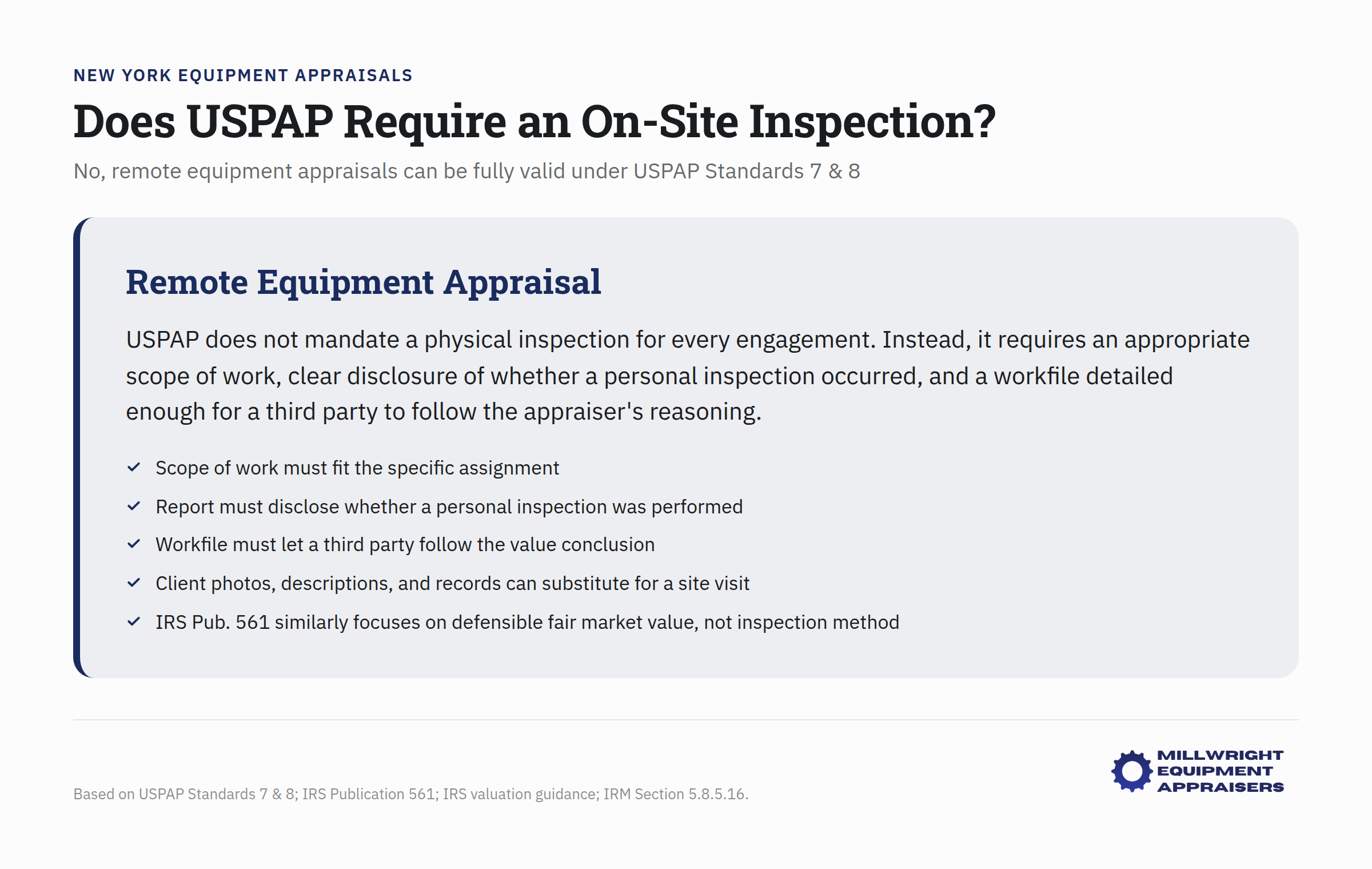
No. The Uniform Standards of Professional Appraisal Practice, which governs personal property appraisals under Standards 7 and 8, does not mandate a physical inspection for every engagement. What it does require is that the appraiser define an appropriate scope of work for the assignment, disclose clearly in the report whether a personal inspection was performed, and support the value conclusion with a workfile detailed enough that a third party could follow the reasoning.
That distinction matters. USPAP is method-neutral on inspection: it cares that the scope of work fits the assignment and that the report is transparent about what was and was not physically examined. Industry guidance on machinery valuation echoes this, noting that when a site visit is impractical, an appraiser can rely on client-supplied descriptions, photographs, and records, provided the report explains how those materials were used and what limitations that introduces.
The IRS applies a parallel standard for its own purposes. IRS guidance on valuing business assets and IRS Publication 561 focus on arriving at a defensible fair market value supported by adequate data, not on requiring a specific inspection method. Internal IRS procedures for evaluating unusual or specialized property likewise point examiners toward securing an appraisal from a qualified, knowledgeable appraiser rather than dictating how that appraiser gathers field data.
Key takeaway: A remote equipment appraisal is not a lesser version of an on-site appraisal. It is a different, equally valid scope of work, as long as the report discloses the method and the supporting documentation is thorough enough to hold up under scrutiny.
What We Need From You: Records and Photos
A remote appraisal is only as strong as the documentation behind it. Before analysis begins, we ask clients to assemble an asset list and supporting records for every location included in the engagement.
For each piece of equipment, we typically need the following documentation:
- Serial number, make, model, and year: the identifying information that lets us match the asset to manufacturer specifications and market comparables
- Hours of use or mileage: wherever the equipment tracks it, since utilization drives depreciation as much as chronological age
- Condition notes: a plain description of mechanical issues, recent repairs, or known deficiencies
- Maintenance and service records: logs that demonstrate how the equipment has been cared for over its life
- Original purchase documentation: invoices, bills of sale, or capitalization schedules showing acquisition cost and date
On the photo side, quality matters more than quantity. We ask clients to capture:
- Multiple exterior angles of each machine, showing overall condition and any visible damage
- A close-up of the serial or data plate, legible enough to confirm the exact model and specifications
- Interior shots of the engine compartment or cab, where applicable
- Close-ups of known wear points such as tires, tracks, hydraulic lines, or cutting surfaces
Our used equipment valuation guidance covers how condition, utilization, and market comparables interact to produce a fair market value conclusion, which is worth reviewing before you start pulling records together.
How the Remote Appraisal Process Works
The engagement moves through a consistent sequence regardless of how many sites are involved.
- Build the Asset List
- You compile a master inventory across all locations, whether that is a single warehouse in Queens or facilities spread from Long Island to the Hudson Valley.
- Collect Photos and Records
- Your team gathers the documentation and photographs described above for each asset, organized by location.
- Appraiser Review and Market Research
- Our appraiser reviews the submitted materials, researches comparable sales and market data, and applies the cost, market, or income approach appropriate to each asset class.
- Draft Analysis and Clarifying Questions
- If a serial number is unreadable or a maintenance gap raises a question, we follow up directly rather than guessing.
- Report Delivery
- You receive a USPAP-compliant report documenting the scope of work, the inspection method for each asset, the data relied upon, and the final value conclusions.
Pro tip: Organize your documentation by location and asset ID before you submit it. A clean submission shortens the analysis phase significantly, since our appraisers spend less time chasing down which photo belongs to which forklift.
When an On-Site Visit Still Makes Sense
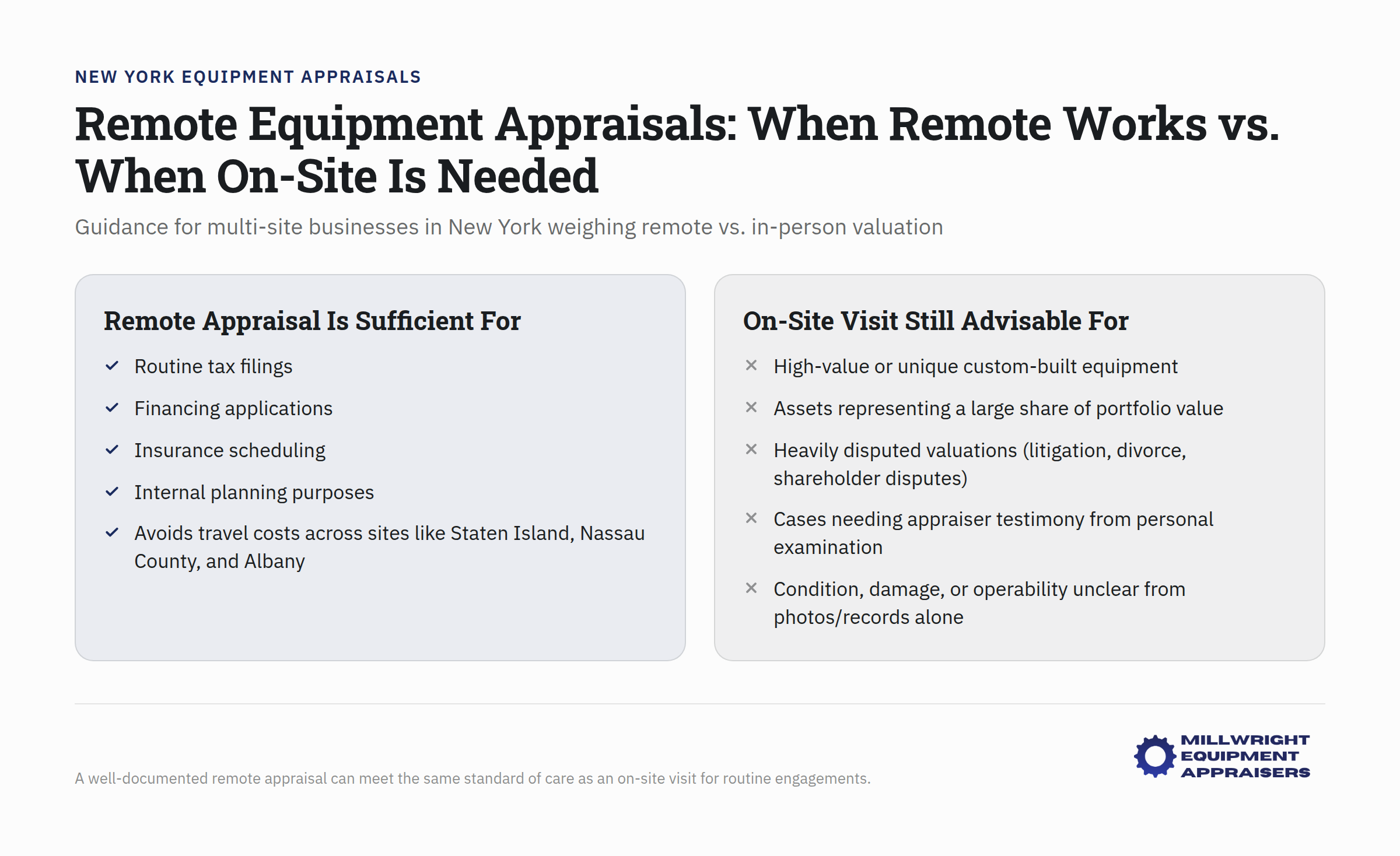
Remote appraisal is not the right fit for every assignment. A physical inspection is still advisable when:
- The asset is high-value or unique: a piece of custom-built production equipment or a single machine representing a large share of portfolio value warrants direct examination
- The valuation is heavily disputed: litigation, divorce proceedings, or shareholder disputes often benefit from an appraiser who can testify to having personally examined the asset
- Condition cannot be assessed from documentation alone: if photos and records leave real uncertainty about mechanical condition, hidden damage, or operability, an on-site visit resolves what paperwork cannot
For most routine engagements, tax filings, financing, insurance scheduling, and internal planning among them, a well-documented remote appraisal meets the same standard of care as an on-site visit while avoiding the cost of driving between Staten Island, Nassau County, and a plant near Albany in a single project.
What a Remote Appraisal Costs
Engagements are quoted as a fixed fee before work begins, never billed hourly. The fee is driven by the scope of the assignment: how many assets are included, how many locations are involved, how complete the records are, and whether the report needs to meet IRS-qualified reporting standards or a standard reporting format. It is never priced off the market value of the equipment itself. A portfolio of ten forklifts across three boroughs and a machine shop in Rochester is priced based on that scope, the same way it would be if the equipment were worth considerably more or less.
Machinery and equipment appraisals through our team typically run from $295 for standard reporting and $395 for IRS-qualified reporting, with most multi-asset engagements landing between $695 and $3,000 depending on the number of assets, locations, and depth of analysis required. Larger, more complex portfolios can run higher.
Getting Your Portfolio Appraised the Right Way
A business with machinery spread from the Bronx to Buffalo does not need to choose between a defensible appraisal and a manageable timeline. A remote engagement, built on a thorough asset list, clear photographs, and complete maintenance and purchase records, gives you a USPAP-compliant valuation of your entire equipment portfolio without weeks of coordinated site visits.
Our appraisers hold credentials including the ASA, NEBB's CMEA designation, CAGA, and ISA, and every report is prepared in accordance with USPAP regardless of how many New York locations it covers. If your equipment is spread across the state and you need one coordinated valuation, request an appraisal and we will scope the engagement to your locations and asset count.
This article is provided for general informational purposes only and does not constitute legal, tax, or financial advice. Readers should consult a qualified attorney or CPA regarding their specific circumstances.