
Blog
New York's Estate Tax Cliff and What It Means for Equipment-Heavy Businesses
New York's estate tax has no gradual phase-out: cross 105% of the exclusion amount and the entire estate loses it, not just the amount over the line. For contractors, machine shops, and agricultural operations, that makes a precise equipment appraisal the difference between owing nothing and owing tax on the whole estate.
Most people assume state estate taxes work like the federal system: you get an exemption, and anything above it gets taxed at the margin. New York does not work that way. New York has a hard cliff built into its estate tax, and if a taxable estate exceeds that cliff by even a small amount, the exclusion disappears entirely and the tax is calculated on the full estate, not just the excess.
That structure matters most for estates sitting near the line, and few estates sit closer to the line unpredictably than those built around equipment. A contracting business with excavators and dump trucks, a machine shop full of CNC equipment, an auto shop with lifts and diagnostic tools, or a farm with tractors and grain handling equipment can swing by hundreds of thousands of dollars depending on whether the executor relies on depreciated book value or an actual fair market value appraisal. We've covered the basics of New York estate tax and equipment appraisal before. This piece goes deeper into the cliff mechanic itself and why it changes the stakes for equipment-heavy estates specifically.
If you're the executor of an estate like this, the equipment valuation isn't a formality to get through quickly. It's one of the few variables you can still control before the return is filed, and it's often the variable with the biggest swing. Our equipment appraisal service is built around exactly this kind of estate-tax engagement, and for estates working through probate, our guide to equipment appraisal for probate in New York covers the Surrogate's Court side of the process in more detail.
What Is New York's Estate Tax Cliff?
New York's estate tax cliff means that once a taxable estate exceeds 105% of the state's basic exclusion amount, the exclusion is eliminated entirely and the tax applies to the whole estate, not just the portion above the exclusion. This is different from the federal system, which has no such cliff.
Under New York Tax Law, the basic exclusion amount shelters an estate from New York estate tax up to that dollar figure. But the shelter only applies cleanly if the estate stays within 105% of that amount. Cross that 105% line and the exclusion is gone. The New York State Department of Taxation and Finance's estate tax guidance confirms this structure: estates that fall between the exclusion amount and 105% of it are in a phase-out range, and estates above 105% lose the exclusion altogether.
For New York residents, the filing test generally looks at the federal gross estate, increased by includible taxable gifts, rather than simply the value of probate assets. That means life insurance proceeds, retirement accounts, jointly held property, and business interests, including equipment, can all pull an estate toward the threshold even if none of it passes through a will.
Watch out: Executors sometimes assume that if an estate is "a little over" the exclusion amount, only the excess gets taxed, the way it would under a simple marginal system. In New York, that assumption is wrong once the estate crosses 105% of the exclusion. At that point, the whole estate is exposed, not just the portion above the line.
How the 105% Threshold Is Calculated
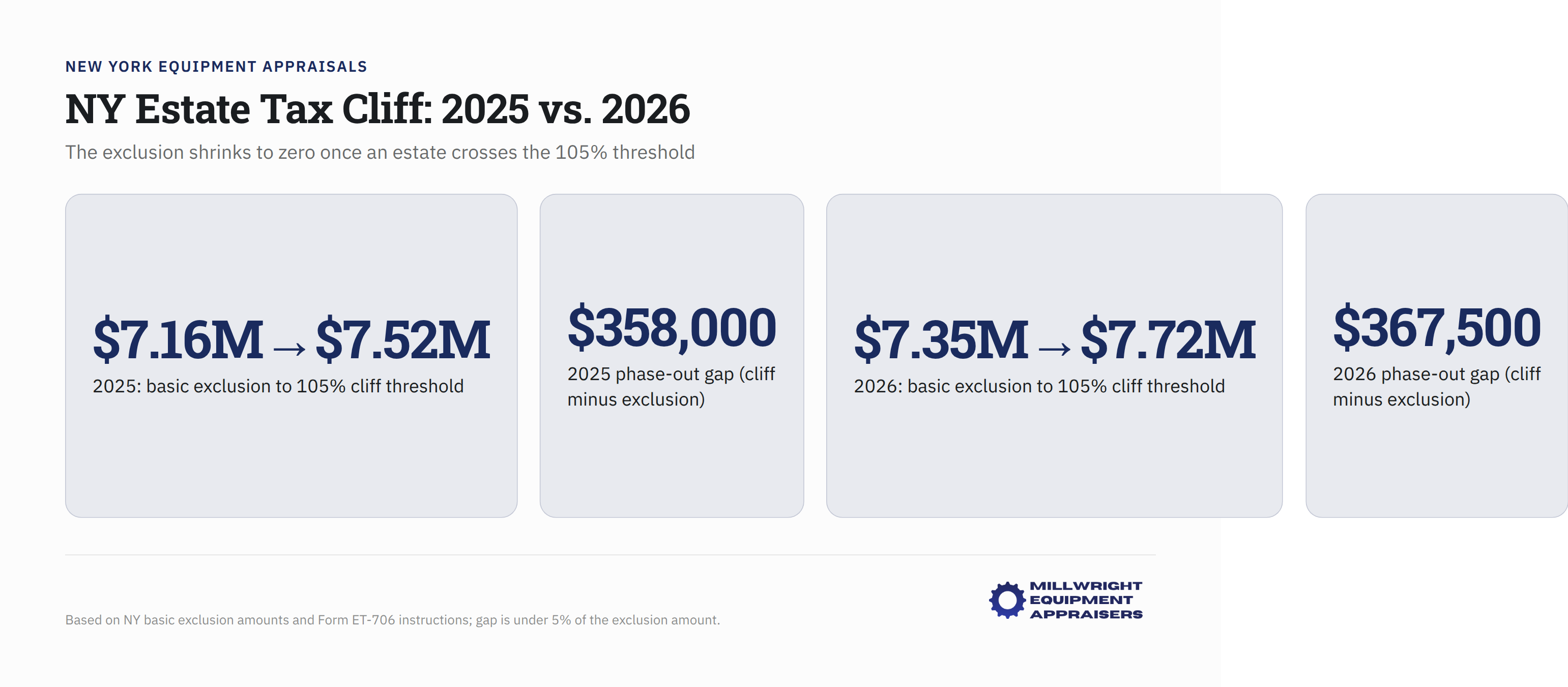
The cliff threshold is calculated by multiplying the year's basic exclusion amount by 1.05. For 2025 deaths, New York's basic exclusion amount is $7,160,000, which puts the cliff at $7,518,000. For 2026 deaths, the exclusion rises to $7,350,000, putting the cliff at $7,717,500.
| Date of death | Basic exclusion amount | 105% cliff threshold |
|---|---|---|
| 2025 | $7,160,000 | $7,518,000 |
| 2026 | $7,350,000 | $7,717,500 |
The gap between the exclusion amount and the cliff threshold, $358,000 in 2025 and $367,500 in 2026, is the entire phase-out band. Inside that band, the exclusion shrinks according to a worksheet in the Form ET-706 instructions. Above the cliff, the exclusion is zero and New York's graduated rates, which run from 3.06% up to a top rate of 16%, apply to the entire taxable estate.
That band is narrow. For a 2025 estate, it covers less than 5% of the exclusion amount itself. An estate can move from fully sheltered to fully taxed because of a single asset that was undervalued, and equipment is one of the easiest categories to undervalue without realizing it.
Why Equipment-Heavy Businesses Are Especially Exposed
Equipment-heavy estates are exposed to the cliff because depreciated book value and tax depreciation schedules have no relationship to fair market value, and fair market value is what both federal and New York law require. Under both federal and New York law, property in a gross estate is valued at its fair market value as of the date of death, or the alternate valuation date if elected, using the same willing buyer, willing seller standard. The IRS Form 706 instructions describe this standard in detail, and New York's estate tax piggybacks on the federal definition of the gross estate.
That standard creates a specific trap for equipment. A fleet of excavators, a bank of CNC machines, a walk-in cooler and line equipment in a restaurant, or a set of tractors and implements on a working farm may be fully or mostly depreciated on the company's books. Fully depreciated on paper does not mean worthless in the market. A 10-year-old excavator with low hours and a strong maintenance record can carry real resale value even though its book value sits near zero.
Several factors drive this gap between book value and fair market value:
- Depreciation schedules are a tax accounting convention, built around recovery periods set by the tax code, not around what a buyer would actually pay for the equipment today.
- Condition and hours matter more than age alone. Two machines of the same model year can have very different resale values depending on maintenance history and usage.
- Marketability varies by equipment type. Common equipment with an active secondary market (trucks, trailers, standard machine tools) often holds value better than highly specialized or custom equipment.
- Business value is not the same as asset value. A company's equipment can be worth one figure on its own and contribute to a different figure once it's considered as part of an operating business with earnings, contracts, and goodwill.
- Secured debt and other deductions affect the taxable estate, but only to the extent they satisfy the applicable estate-tax documentation requirements.
Key takeaway: An executor who simply carries equipment forward at its depreciated book value, rather than obtaining a fair market value appraisal, is often understating the taxable estate, sometimes by a wide enough margin to miss the cliff entirely in their initial estimate.
A Worked Example: Crossing the Cliff by a Few Hundred Thousand Dollars
Consider a 2025 estate for the owner of a mid-size contracting business. Real estate, investment accounts, and other non-equipment assets total $7,300,000. The business also owns a fleet of excavators, dump trucks, and attachments carried on the company's books at a depreciated value of $150,000.
Using book value, the executor's initial estimate of the taxable estate is $7,450,000. That figure falls above the $7,160,000 exclusion amount but below the $7,518,000 cliff threshold, meaning the estate sits inside the phase-out band and a reduced exclusion would still apply.
An independent appraisal of the same equipment, reflecting actual condition, hours, and current resale demand, concludes a fair market value of $420,000, a swing of $270,000 over book value. That moves the taxable estate to $7,720,000, which exceeds the $7,518,000 cliff by $202,000.
| Scenario | Equipment value used | Taxable estate | Result |
|---|---|---|---|
| Book value estimate | $150,000 | $7,450,000 | Inside phase-out band, partial exclusion applies |
| Appraised fair market value | $420,000 | $7,720,000 | Over 105% cliff, exclusion eliminated entirely |
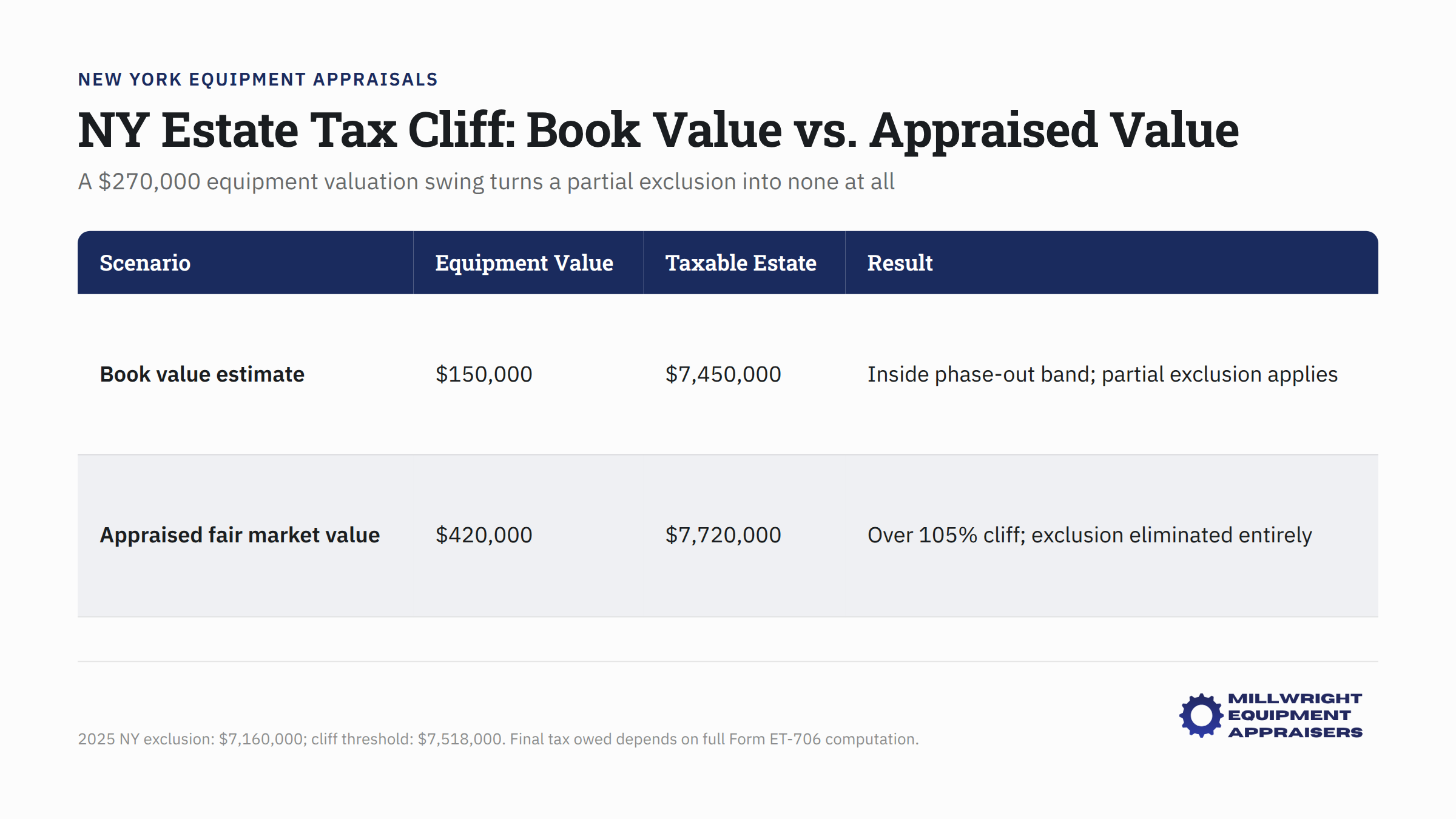
Under the book-value estimate, the estate stays in the phase-out band and the exclusion, though reduced, still shelters a meaningful portion of the estate. Under the appraised figure, the exclusion disappears completely and New York's graduated rates apply to the full $7,720,000, not just the $202,000 above the cliff. The exact dollar amount owed depends on the full Form ET-706 computation, including deductions, prior taxable gifts, and the applicable rate brackets, but the directional result is clear: crossing the cliff by roughly $200,000 in equipment value can turn a tax bill of close to zero into one in the hundreds of thousands of dollars.
Why a Defensible Appraisal Matters More in New York Than in Non-Cliff States
In a straight marginal tax system, a valuation dispute only affects the tax on the disputed increment. If an appraiser and the taxing authority disagree by $100,000, the dispute is worth whatever tax rate applies to that $100,000. In New York's cliff system, a $100,000 disagreement near the threshold can determine whether the entire estate is taxed or whether none of it is.
That asymmetry is exactly why a documented, defensible, date-of-death valuation matters more here than it would in a state (or at the federal level) without a cliff. An informal estimate, a verbal opinion from an equipment dealer, or a carried-forward book value is a weak foundation for a position that could swing hundreds of thousands of dollars in either direction.
A few practical points follow from this:
- The appraisal needs a clear valuation date. Equipment values move with the market, so the report should tie its conclusion to the date of death or the alternate valuation date, not an arbitrary later date.
- The methodology needs to be documented, not just asserted. A credentialed appraiser should explain how comparable sales, cost, or income data support the concluded value.
- The report should be prepared in accordance with USPAP (the Uniform Standards of Professional Appraisal Practice), published by The Appraisal Foundation, so it holds up to scrutiny from the state, the IRS, or opposing counsel in a contested estate.
- The fee is quoted as a fixed amount after scoping the assets, not billed hourly. A machine shop with a dozen pieces of equipment and a contracting fleet with forty pieces of rolling stock are different engagements, and the scope, not the concluded value, is what drives the fee.
Our appraisers hold credentials with organizations including the ASA, CAGA, NEBB, and ISA, and we prepare every equipment appraisal in accordance with USPAP. For an estate sitting anywhere near New York's threshold, that level of documentation is what gives the executor, the estate's attorney, and the Department of Taxation and Finance a number they can actually rely on.
What This Means for Executors of Equipment-Heavy Estates
If you're settling an estate that includes a contracting business, a machine shop, an auto shop, or a farm, don't treat the equipment line as a rounding error. Get an independent fair market value appraisal before you file, not after a dispute arises. Given how close New York's cliff sits to a typical mid-size business estate once equipment, real estate, and other assets are added up, a few hundred thousand dollars of under-valued machinery can be the difference between a clean filing and a tax bill that reaches into six figures.
This article is provided for general informational purposes only and does not constitute legal, tax, or financial advice. Readers should consult a qualified attorney or CPA regarding their specific circumstances.