
Blog
Dividing Business Equipment in a New York Divorce: How Equitable Distribution Works
New York courts require a defensible value for business machinery and tools before they can divide marital property, and an independent equipment appraisal is often what makes that number hold up. Here is how equitable distribution treats equipment, why the valuation date matters, and what a compliant appraisal needs to show.
When a marriage ends and one or both spouses own a business, the machinery, tools, and equipment sitting on the shop floor or in the office often turn into the most contested line item on the balance sheet. New York courts cannot divide what they haven't valued, and equipment tends to be harder to pin down than a bank account or a house. This article walks through how New York's equitable distribution framework treats business equipment, when a spouse needs an independent appraisal, and what that report has to accomplish for the court.
If your matter involves machinery, tools, or production equipment tied to a closely held business, our New York equipment appraisal service prepares USPAP-compliant valuations built specifically for divorce and equitable distribution proceedings.
New York Is an Equitable Distribution State, Not a Community Property State
New York does not split marital property 50/50. Under Domestic Relations Law Section 236(B), the court divides marital property equitably, meaning fairly, based on a list of statutory factors rather than a fixed formula.
Those factors include the income and property of each spouse, the length of the marriage, the tax consequences of the distribution, any waste or transfer of marital assets, and the liquid or non-liquid character of the property being divided. Business equipment usually falls into that last category: it isn't cash, and turning it into cash (through a sale, an auction, or a forced liquidation) changes its value from what it's worth sitting in active use. As industry practice generally recognizes in equitable distribution work, the goal is arriving at a just and fair compensation for property that was once held jointly, not necessarily forcing a sale.
One statutory factor deserves particular attention here: New York law specifically flags the difficulty of determining the value of certain assets, including interests in a business, and whether one spouse should keep the business so it can keep operating without interference from the other. That's a strong signal that lawmakers expected business assets, and the equipment inside them, to require real appraisal work rather than a rough guess.
What Counts as Marital vs. Separate Property When a Business Owns Equipment?
Marital property generally includes anything acquired by either spouse during the marriage and before the divorce action was filed, regardless of whose name is on the title. Separate property covers what a spouse owned before the marriage, gifts and inheritances received individually, and certain passive appreciation on separate assets, as DRL 236(B) and the case law interpreting it lay out.
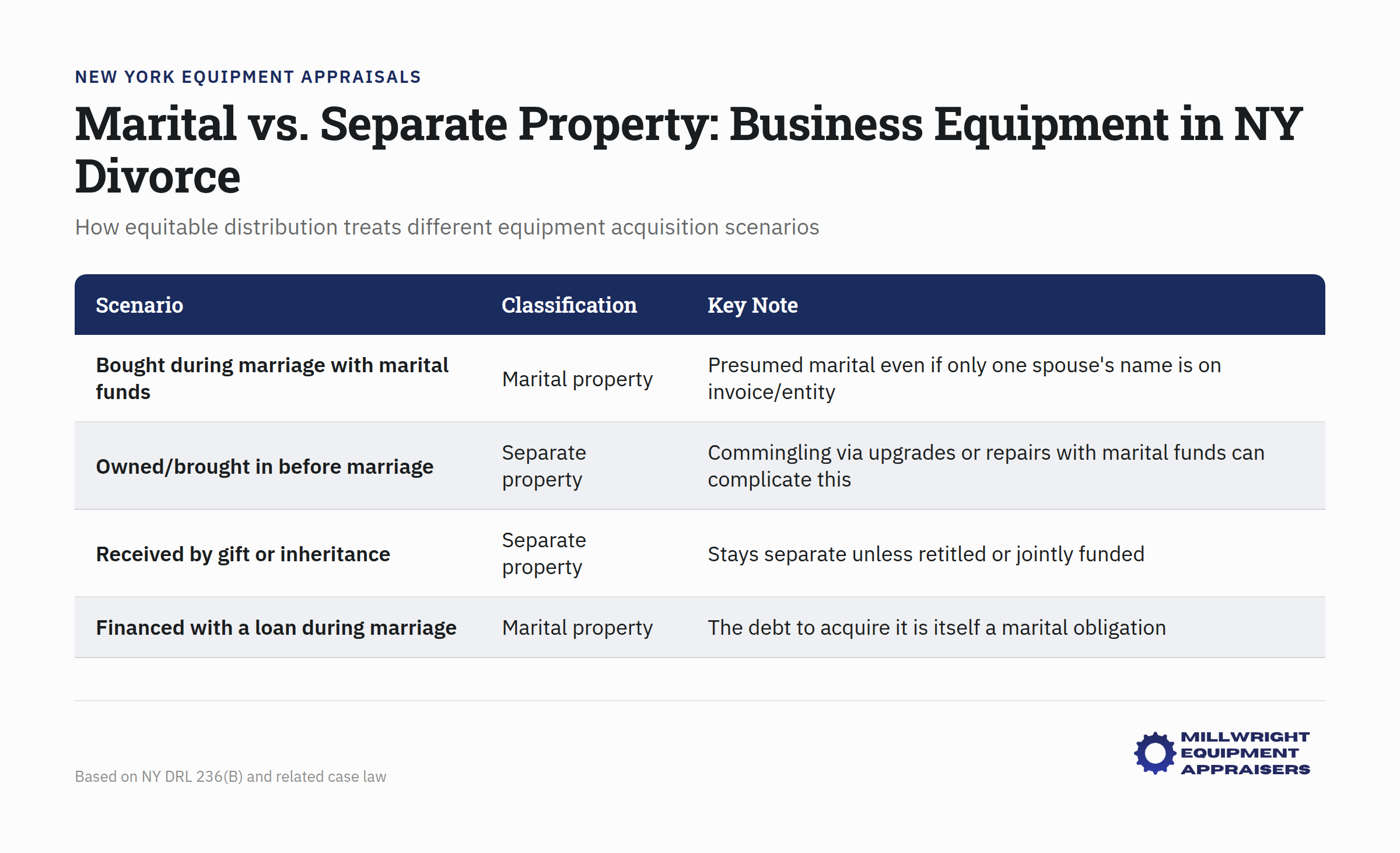
Applied to a business's equipment, that distinction plays out a few different ways:
- Equipment purchased during the marriage with marital funds is presumptively marital property, even if only one spouse's name is on the invoice or the business entity.
- Equipment a spouse owned or brought into the business before the marriage may remain separate property, though commingling with marital funds for upgrades, repairs, or replacement parts can complicate that line.
- Equipment received by gift or inheritance, even during the marriage, generally stays separate property as long as it wasn't retitled or funded jointly.
- Equipment financed with a loan taken out during the marriage is typically treated as marital, since the debt used to acquire it was itself a marital obligation.
These categories rarely sort themselves out cleanly on paper. A machine bought five years into a fifteen-year marriage, upgraded twice with business revenue, sitting inside a company one spouse started before the wedding, needs a documented history and a valuation approach that can separate what's marital from what isn't. An equipment appraiser working from serial numbers, purchase records, and depreciation schedules is often the only way to build that record credibly.
Why the Valuation Date Matters for Depreciating Equipment and Growing Businesses
New York courts have discretion to set the valuation date for marital property anywhere between the commencement of the divorce action and the date of trial. That window can span months or years, and the choice of date can swing the appraised value of equipment substantially.
Courts generally lean toward an "active vs. passive" distinction when picking the date. Assets that grew or changed in value mainly through market forces, sometimes called passive assets, are often valued closer to trial. Assets whose value depends on one spouse's ongoing labor and management, such as an operating business, are more often valued as of the commencement date, so the non-owner spouse doesn't end up sharing in growth that the other spouse alone generated after the marriage effectively ended.
Equipment sits at an interesting intersection of both dynamics. Machinery and tools depreciate on a fairly predictable schedule regardless of who runs the business, which argues for consistency no matter which date is chosen. But the business that owns the equipment may have grown its revenue, added inventory, or expanded its equipment fleet entirely because of one spouse's post-separation effort. That's exactly the scenario the statute anticipates when it singles out businesses as assets that are difficult to value and sensitive to who continues running them.
Example: A commercial bakery bought a walk-in freezer and a commercial oven during the marriage for $40,000 combined. By the time of trial three years later, depreciation has brought the book value down substantially, but the business itself has doubled its customer base under one spouse's day-to-day management. Valuing the equipment as of the commencement date, separate from the business's post-separation growth, keeps the equitable distribution calculation from crediting one spouse with value created almost entirely by the other's later effort.
How an Independent Equipment Appraisal Supports the Court's Determination
The court needs a specific number, tied to a specific date, and defensible enough to survive cross-examination if the matter goes to trial. An independent equipment appraisal is how attorneys and spouses get there.
A properly scoped appraisal, prepared in accordance with USPAP (the Uniform Standards of Professional Appraisal Practice, published by The Appraisal Foundation), identifies each piece of machinery or equipment individually: make, model, serial number, condition, and the specific effective date the court has set or the parties have agreed to. That level of detail matters because a business valuation alone often treats equipment as a single line item folded into total assets, which doesn't give the court (or opposing counsel) enough to challenge or defend the number.
Most equipment appraisals for divorce and equitable distribution rely on fair market value: the price a willing buyer would pay a willing seller, with neither party under compulsion, as of the effective date. Depending on the assignment, appraisers may also apply value-in-use, which reflects the equipment's worth to the business as an operating asset rather than its liquidation price. Choosing between the two is a legal and factual question, not just a valuation technique, so it's worth confirming with counsel early which standard the case requires.
Key takeaway: A separate equipment appraisal, distinct from the overall business valuation, gives the court a defensible figure it can rely on for the machinery and tools alone, isolated from goodwill, receivables, and other business assets.
Valuing Equipment Apart From the Business's Goodwill
When equipment is a material part of a closely held company's assets, lumping it into a single business valuation number can obscure more than it reveals. Goodwill, customer relationships, and the reputation of the business are intangible and depend heavily on the owner-spouse's continued involvement. Equipment is a tangible, physical asset with an ascertainable fair market value independent of who's running the company next year.
Separating the two matters for a practical reason: a spouse being bought out of marital property has a much easier time accepting, or challenging, a number for a lathe or a delivery truck than a number for "goodwill," which is inherently more subjective. An itemized equipment schedule, appraised on its own, gives both sides and the court something concrete to negotiate around, whether or not the parties ultimately agree on the harder question of what the business itself is worth.
Practical Steps for Commissioning a Compliant Appraisal
Getting a usable equipment appraisal into a New York divorce case is mostly a matter of sequencing and documentation. The steps below reflect how these engagements typically move from first conversation to a finished report.
- Confirm the Valuation Date With Counsel
- Before any appraiser inspects a single machine, the attorney needs to establish (or anticipate) the effective date the court will use, whether that's the commencement date, the trial date, or another date the parties stipulate to.
- Gather Purchase and Financing Records
- Invoices, loan documents, and any records showing when equipment was acquired and with what funds help the appraiser and the court sort marital property from separate property.
- Compile an Equipment Inventory
- A list of every relevant asset, ideally with make, model, and serial number, speeds up the appraisal and reduces the chance of a disputed omission later.
- Engage an Independent, Credentialed Appraiser
- Appraisers working in this space typically hold credentials through organizations such as the American Society of Appraisers, the Certified Appraisers Guild of America, or NEBB Institute (Certified Machinery & Equipment Appraiser), and prepare reports in accordance with USPAP.
- Review the Draft Report With Counsel
- Before the report is finalized, counsel should confirm the effective date, value premise (fair market value or value-in-use), and asset descriptions align with the case's legal strategy.
- Submit the Report as Part of the Financial Disclosure or Trial Exhibits
- A completed, USPAP-compliant appraisal becomes part of the record the court relies on to reach its equitable distribution determination.
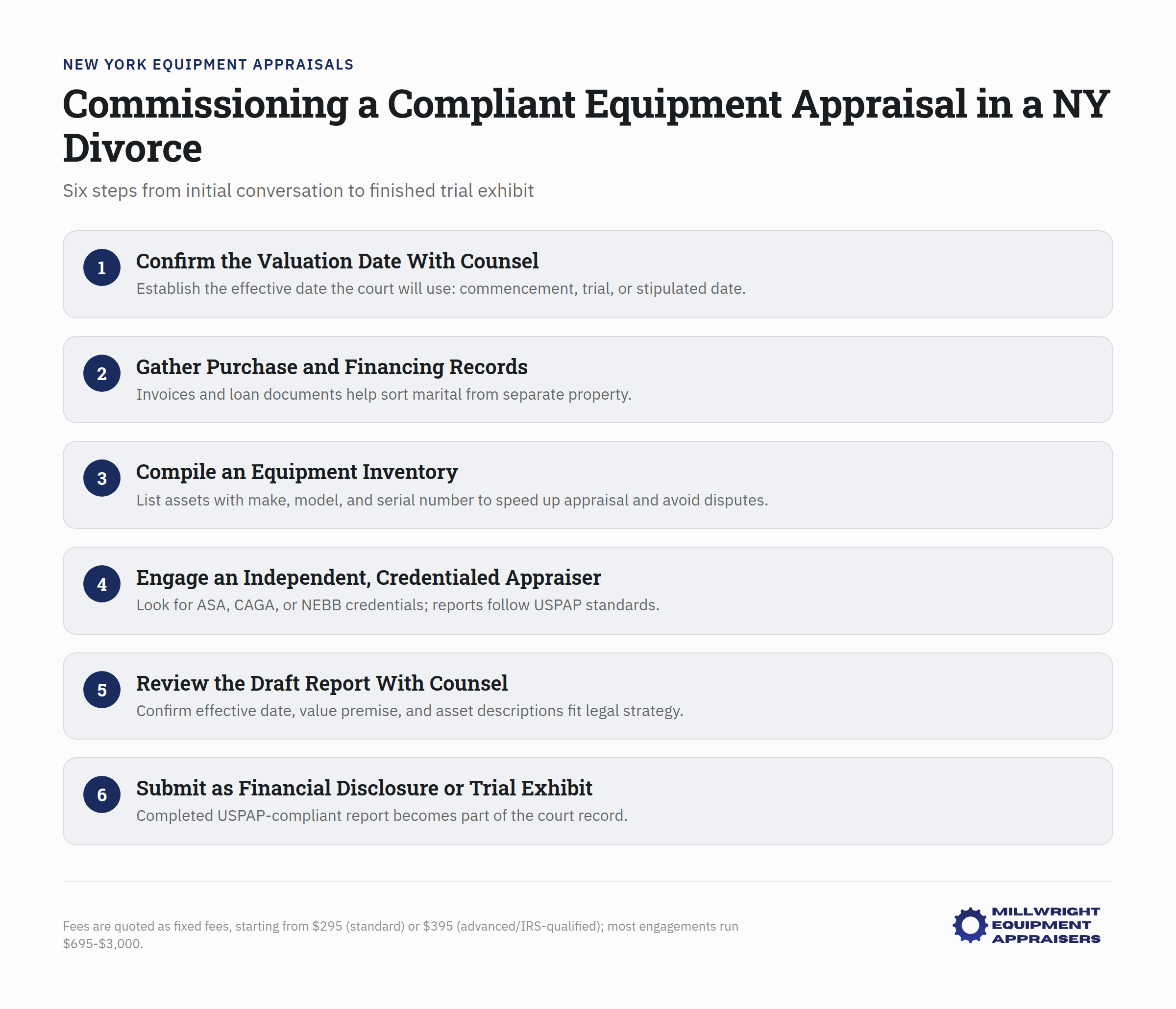
Engagements like these are quoted as a fixed fee once the scope, the number of assets, and the intended use are known, never billed by the hour. For machinery and equipment appraisals generally, fees start from $295 for a standard report and from $395 for an advanced, IRS-qualified level of reporting, with most engagements falling between $695 and $3,000 depending on the number of assets and the depth of analysis the case requires.
Business equipment disputes rarely resolve themselves through guesswork or a quick online estimate. A documented, independent appraisal gives both spouses, their attorneys, and the court a number they can actually rely on, and it's usually far less expensive than the cost of relitigating a disputed figure at trial. If your situation touches on how the business itself should be valued alongside its equipment, our guide to New York estate and business equipment valuation covers the related considerations business owners face outside of divorce.
This article is provided for general informational purposes only and does not constitute legal, tax, or financial advice. Readers should consult a qualified attorney or CPA regarding their specific circumstances.