
Blog
How to Donate Equipment to a New York Charity and Claim the Tax Deduction
Donating equipment to a New York charity or university can unlock a real tax deduction, but once the claimed value tops $5,000 the IRS requires a qualified appraisal and Form 8283 before you can take it. Here is what that appraisal must include, when it has to be dated, and which New York organizations actually accept donated machinery and tools.
Giving old machinery, shop tools, or laboratory equipment to a New York nonprofit or school feels simple: load the truck, drop it off, take the deduction. The IRS disagrees once the numbers get large enough. If the claimed deduction for an item or group of similar equipment exceeds $5,000, federal rules require a qualified appraisal and a signed Form 8283 before that deduction holds up on your return. This guide covers who can receive the donation, what triggers the appraisal requirement, and where New York donors actually send used equipment.
Which New York Organizations Qualify for the Deduction?
The recipient generally must be an organization described under Internal Revenue Code Section 170(c), which includes most charities, and public or qualifying universities. A SUNY campus, a CUNY college, or a registered 501(c)(3) nonprofit will typically qualify; a for-profit resale shop or an informal community group will not.
Accepting the equipment does not make the organization a qualified appraiser, and it does not set the value for your deduction either. The charity's own estimate of what the item is worth, even if it is written down on a donation receipt, is not a substitute for an independent valuation once you cross the federal threshold. Before donating anything of real value, it is worth having our equipment appraisal service scope the item so you know where you stand before you sign anything with the recipient.
The $5,000 Threshold That Triggers a Qualified Appraisal
A qualified appraisal and Form 8283, Section B, are required once the claimed deduction for an item or group of similar donated equipment exceeds $5,000, according to IRS Publication 561. This is not a per-donation limit on the equipment's actual worth; it is a limit on what you are claiming, and it applies whether you are donating one piece of equipment or a group of similar items to the same organization.
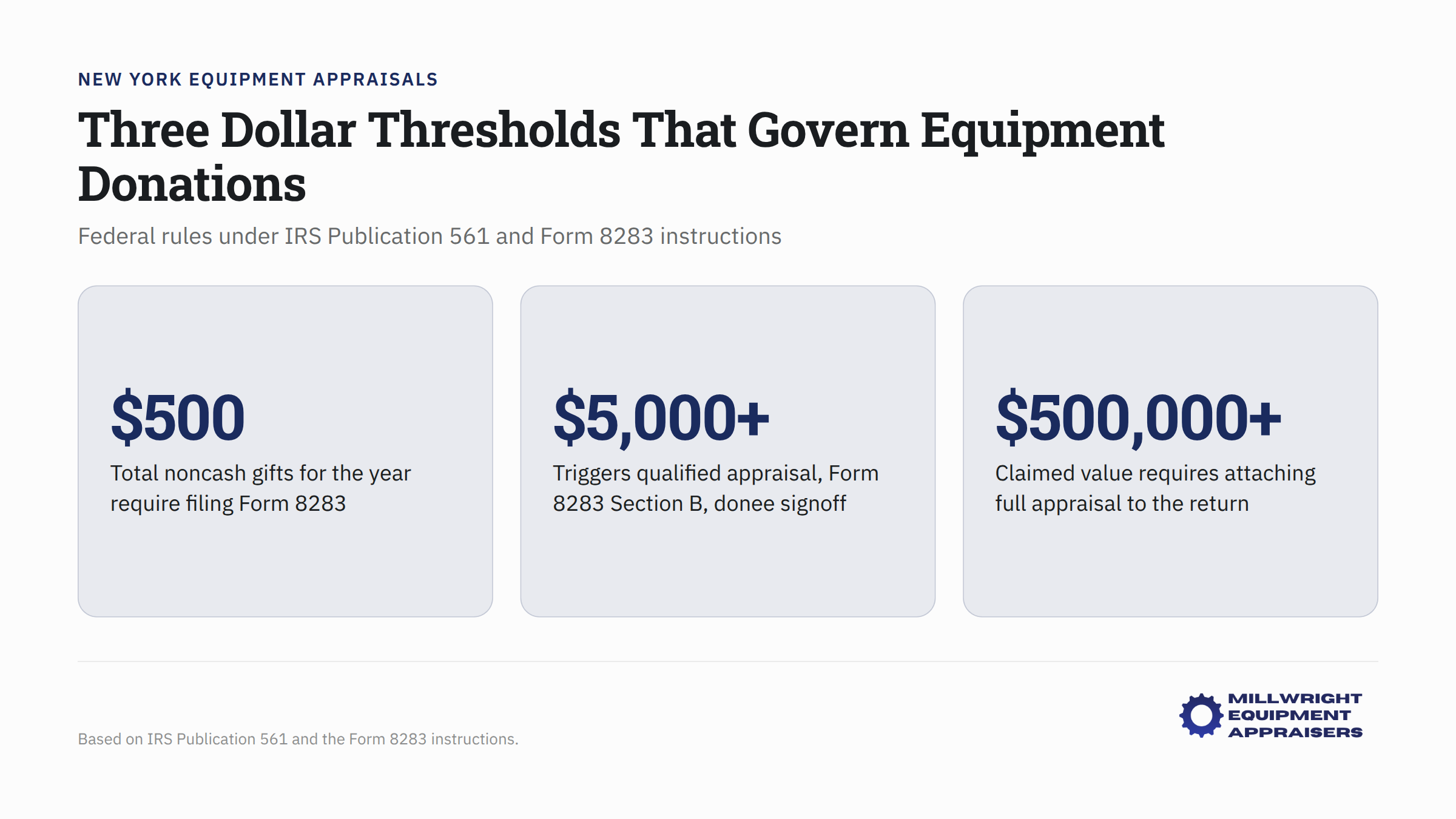
A few related thresholds matter just as much:
- $500 total noncash contributions for the year: Form 8283 must be filed with the federal return once your combined noncash giving crosses this line.
- More than $5,000 for one item or group of similar items: triggers the qualified appraisal requirement, Form 8283 Section B, and a signed acknowledgment from the donee, per the Form 8283 instructions.
- More than $500,000 claimed for donated property: the qualified appraisal itself must be attached to the return, not just summarized on Form 8283.
One appraisal can cover a full group of similar items donated to the same organization in the same tax year, so a shop's worth of hand tools or a lab's worth of bench equipment given to one university does not necessarily need a separate report for every piece. It does mean the items need to be inventoried and described individually within that one report.
What Makes an Appraisal "Qualified" Under IRS Rules?
A qualified appraisal is a written report prepared, signed, and dated by a qualified appraiser who meets the education and experience standards in Treasury Regulations, and who has no disqualifying relationship to the donor or the property. A donor, an employee of the donor, or a general appraiser with no equipment background will not satisfy this standard, even if the paperwork looks complete.
Per the Form 8283 instructions, the report needs to include a detailed description of the equipment, its physical condition, the valuation date, the method used to arrive at value, and the appraiser's qualifications. For used machinery, that typically means serial numbers, model numbers, hours or mileage where applicable, maintenance history, and whether the unit is operational, leased, or encumbered. A comparable-sales approach, adjusted for age and condition, is the most common method for used equipment; a cost approach that nets out depreciation and obsolescence is used when good comparables are scarce.
Watch out: You cannot deduct the appraisal fee itself as part of the charitable contribution. The fee is a cost of substantiating the gift, not part of the gift.
Timing Rules: When the Appraisal Must Be Dated
The appraisal has to be dated no earlier than 60 days before the contribution and no later than the due date, including extensions, of the return on which you first claim the deduction. Donors who wait until tax season to think about the appraisal often run out of runway, especially if the equipment needs to be inspected in person or inventoried across multiple sites.
Example: A manufacturer donates a group of CNC machines to a SUNY technical program in October. The appraisal needs a valuation date tied to the October contribution date, and the signed report needs to be in hand before the following April's filing deadline (or the extended deadline, if one is filed).
Form 8283 is an appraisal summary, not the appraisal itself. The qualified appraiser signs the appraiser's declaration on the form, and the receiving organization generally signs to acknowledge receipt. That donee signature confirms the gift was received; it does not certify the value.
Where New York Donors Actually Send Equipment
Finding a recipient that both wants the equipment and can legally accept it is half the battle. A handful of New York organizations have a documented history of taking donated tools, shop machinery, and training equipment:
- Goodwill Industries of Greater New York and Northern New Jersey: accepts tools and general equipment donations at its donation centers, typically for resale rather than programmatic reuse.
- Materials for the Arts: a New York City program that redistributes donated tools, equipment, and supplies to public schools and nonprofit organizations.
- SUNY and CUNY technical and workforce programs: campuses with advanced manufacturing or trade curricula, such as Hudson Valley Community College and SUNY Cobleskill, have accepted donated shop machinery and training equipment to support hands-on instruction.
- CUNY's City Tech: runs a foundation-administered donation process for equipment gifts intended for academic or lab use.
Medical equipment is the exception, not the rule. Acute-care hospitals generally cannot accept individual medical equipment donations directly from members of the public; NewYork-Presbyterian, for instance, directs would-be donors to other organizations rather than taking equipment at the hospital itself. If you are sitting on diagnostic or clinical equipment, a vocational program or a reuse nonprofit is usually the more realistic landing spot than a hospital.
Related Use and Why It Matters for Your Deduction
The full fair market value deduction generally depends on the recipient putting the equipment to a use related to its exempt purpose. Laboratory equipment going to a university for student research or instruction is a strong related-use case. Office equipment donated for general administrative use at the same university is a closer call, and equipment that gets sold off almost immediately after the gift typically does not qualify for the enhanced valuation at all.
If the organization disposes of equipment valued above $5,000 within a short window after accepting it, and the deduction exceeded your basis in the property, recapture rules under IRS Publication 526 can come into play. Ask the recipient how they intend to use the equipment and get that intention in writing before you finalize the gift.
What an Equipment Donation Appraisal Costs
Appraisal fees are quoted as a fixed fee after we scope the assignment, never billed by the hour. For equipment donations where the appraisal needs to meet IRS qualified-appraisal standards, our advanced reports start at $395, with typical engagements running $695 to $3,000 depending on the number of items, the quality of existing records, and the depth of analysis the valuation method requires. Larger donations involving specialized industrial or laboratory fleets can run $5,000 to $10,000 or more.
The fee reflects the scope of the work: how many assets are in the group, how complete the maintenance and purchase records are, and whether the report needs to meet the IRS-qualified standard or a lighter standard for internal recordkeeping. It is never based on the equipment's appraised value, and no part of a qualified appraisal's fee can be tied to a percentage of that value under federal rules. If you are weighing a donation against other options, it also helps to understand who generally pays the appraisal fee in a typical engagement before you commit.
Building a File That Holds Up
For any equipment donation claiming more than $5,000, keep a file that includes the signed gift or transfer document, the donee's written acknowledgment, a detailed inventory with serial and model numbers, photographs, purchase and maintenance records, the signed qualified appraisal, the completed Form 8283, and documentation of the organization's intended use. If the equipment is later sold or transferred by the recipient, keep a record of that too.
Donating a lathe, a fleet of lab benches, or a stack of CNC machines to a New York school or charity can be a genuinely good outcome for everyone involved: the organization gets working equipment, and you get a legitimate deduction. The paperwork is just the price of making that deduction defensible if the IRS ever asks. Getting the appraisal, the timing, and the Form 8283 details right the first time is far easier than trying to reconstruct them during an audit. If you are ready to move forward, you can request an appraisal and we will scope the engagement before any work begins.
This article is provided for general informational purposes only and does not constitute legal, tax, or financial advice. Readers should consult a qualified attorney or CPA regarding their specific circumstances.